
The short answer
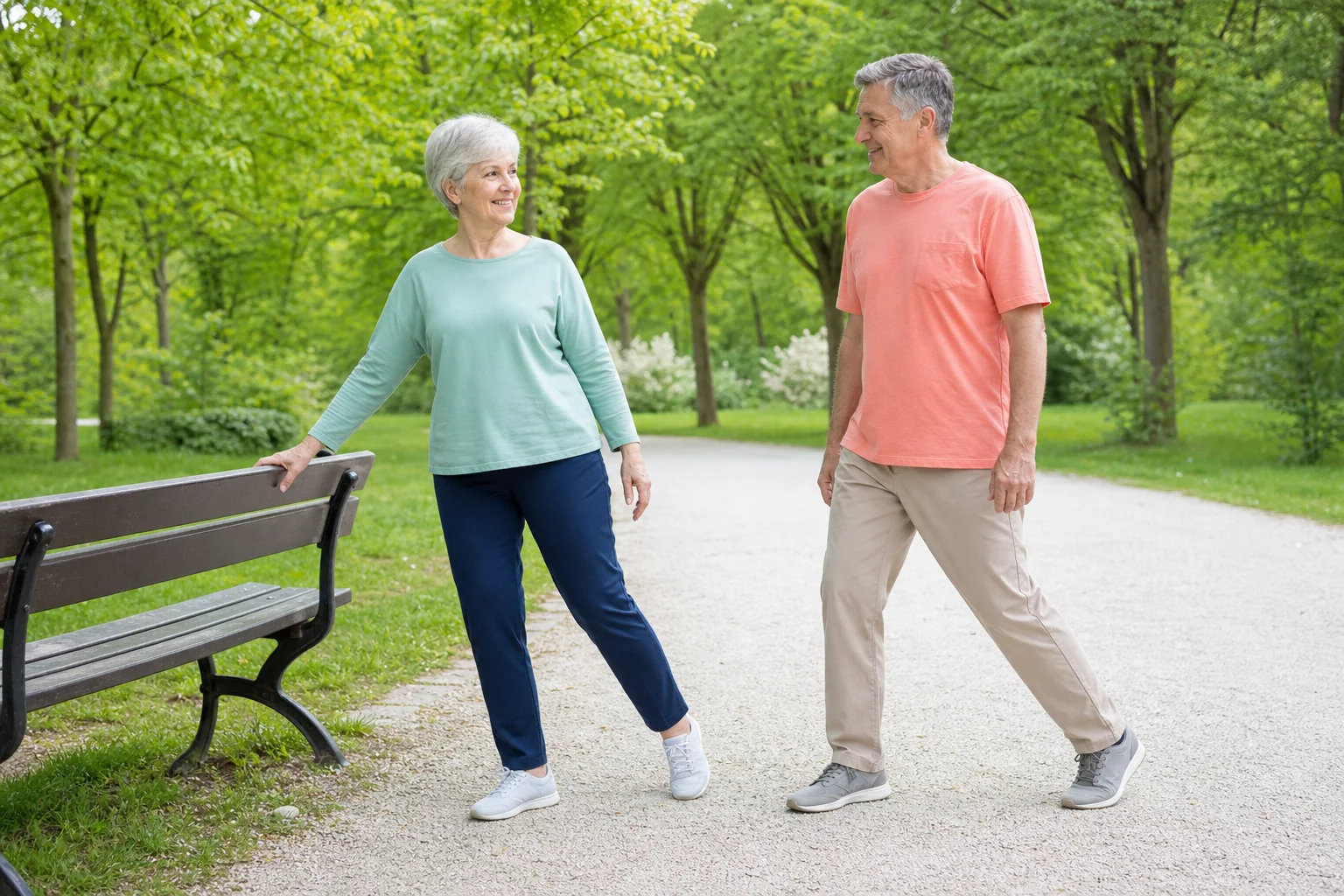
Balance after 60 can be developed through simple, adjustable tasks: a stable stance beside firm support, small weight shifts with both feet down, controlled steps in several directions, a calm turn made with shorter steps and chair rises when appropriate. Start in a safe space and change only one condition at a time. Exercise may support everyday movement, but it cannot guarantee that a person will not fall and it does not replace individual assessment for repeated falls, sudden unsteadiness or new symptoms.
Balance is not one organ or one test
Steadiness emerges from vision, the inner ear, position sense, strength, mobility, attention and the ability to respond with a step. A single one-leg stand cannot show the whole picture. Someone may stand quietly yet feel uncertain while turning, rising, carrying a bag or moving over an uneven surface.
Useful practice therefore connects to the task you want to handle more steadily. It is not a contest to see who can last longest without support. The aim is a repeatable situation in which movement stays controlled and there is an easy route back to a stable position.
Set up the space and choose honest support first
Stand beside a fixed kitchen counter, rail or stable bench that will not slide. Remove loose rugs, cables and objects from the path, use good lighting and choose footwear that does not slip. The back of a light chair or a chair on wheels is not dependable support.
Hand contact is not failure. It is a variable that adjusts the task. If you are unsure, begin with both hands or with another person nearby who can call for help but will not pull you unexpectedly. Do not begin by closing your eyes, lifting a leg high or using an unstable surface.
- Space: Is the path clear, well lit and non-slip?
- Support: Is the object fixed and reachable before stability is lost?
- Exit: Can you shorten the step, place both feet down and stop calmly?
Begin with foot contact and a small weight shift
Choose a comfortable stance around hip width, keep the knees soft and rest a hand on firm support. Notice heel, forefoot and outer-edge contact without forcing the feet into the ground. Shift part of your weight slightly to the right and return to centre, then repeat to the left. Both feet remain down.
Keep the range small enough that the trunk does not have to escape sideways and you can return without rushing. You may similarly shift a little forward and back without making a lifted heel the goal. If unsteadiness increases, reduce the path or add hand contact.
- Contact: Can you feel both feet and name the direction of the shift?
- Control: Can you return to centre without a sudden rescue step?
- Breathing: Does it stay natural rather than being held during concentration?
Practise small steps and turns as everyday life uses them
Beside support, practise a short step forward, sideways and back. First move weight onto the supporting leg, make a small step with the other foot, place it fully and only then transfer as much weight as you can control. Returning is not failure; it is part of the task.
For a turn, avoid twisting planted feet against the floor. Use several shorter steps, look towards the direction of travel and leave yourself room. Rising from a firm, higher chair can add a strength element when suitable, but this page is not a complete strength plan or weekly programme.
Progress one variable instead of collecting tricks
When the simple version is repeatedly calm, change one condition: use lighter hand contact, make the base slightly narrower, add a small look to the side or choose another stepping direction. Do not change support, surface, speed and direction together. You would no longer know what caused a loss of control.
A harder task is not automatically more useful. Closed eyes, a long one-leg stand, fast reaches or a soft unstable surface can add unnecessary risk without matching an everyday need. A good progression keeps a safe way to finish.
- Continue: Movement stays controlled and ordinary walking is not worse afterward.
- Hold: The task is manageable but needs full attention or firmer hand contact.
- Reduce: Rescue steps, growing sway, pain or uncertainty appear.
Repeated falls and sudden change need individual assessment
An online article cannot identify why repeated falls occur. If you have fallen more than once, fear walking enough to restrict ordinary life, or became less steady after an injury, hospital care or a medication change, speak with a doctor or physiotherapist. Assessment can consider vision, hearing, medicines, blood pressure, strength, neurological signs and the environment.
Stop movement for new chest pain, fainting, sudden weakness or numbness, new marked breathlessness, severe dizziness, a sudden intense headache or an acute injury. After a fall involving a head strike or suspected serious injury, seek appropriate medical help. Exercise may form one part of wider prevention; it is not a fall-proof guarantee.
Group evidence supports training, not a personal promise
WHO guidance for older adults includes multicomponent physical activity that emphasises functional balance and strength within a broader active week. CDC also places strength and balance activity in the context of reducing fall risks. These documents offer a population direction, not a compulsory prescription for every individual.
A Cochrane systematic review of studies in community-dwelling older people found support particularly for balance and functional exercise and multicomponent programmes. Participants, settings and programmes varied, and adverse-event reporting was not uniform across studies. A group result therefore cannot become a guarantee for one person or a universal home dose.
One of several calm movement options
Tai Chi within broader balance training
Tai Chi can be one multicomponent movement option, combining slow weight shifts, steps, changes of direction, coordination and attention. It is not treatment, an individual balance test or a guarantee against falls, and it does not replace the aerobic or strength parts of an active week.
The separate Tai Chi and balance page owns the detailed evidence discussion. If you are interested in a practical start in Bratislava, the beginner page explains higher stances, smaller ranges and live feedback; current organisational details are shared privately after a no-obligation WhatsApp message.
Common questions
Must I stand on one leg to train balance after 60?
No. Balance can be practised with both feet down through small weight shifts, steps and turns beside firm support. The task should match your stability and everyday need.
Is it safe to practise balance with my eyes closed?
It is not needed for a home starting point and can increase the challenge sharply. Prefer good lighting, a firm surface and available support; more complex conditions belong in individual guidance.
How often should I practise balance after 60?
Population guidance supports regular multicomponent movement, but there is no universal home dose for everyone. Begin with a short, safe and repeatable opportunity, and discuss frequency with a professional when health limitations are present.
Will balance exercise prevent falls?
Evidence supports balance and functional exercise as part of wider programmes, but no form of training guarantees that a person will not fall. Medicines, vision, surroundings, health conditions and other factors also matter.
Is Tai Chi suitable for balance after 60?
It can be one adjustable form of coordinated multicomponent movement. The same version does not suit everyone; range, support and pace should be adapted, and repeated falls need individual assessment.
Sources
- World Health Organization — Physical activity
Current official framework for multicomponent activity, functional balance and strength in older age; it is not an individual home prescription
- Centers for Disease Control and Prevention — About Older Adult Fall Prevention
Official fall-prevention context including strength and balance activity; risk is multifactorial and the guidance is not a guarantee
- Cochrane — Exercise for preventing falls in older people living in the community
Systematic review of 108 randomised studies in community-dwelling people; supports balance, functional and multicomponent programmes without defining a personal guarantee or universal dose