
The short answer
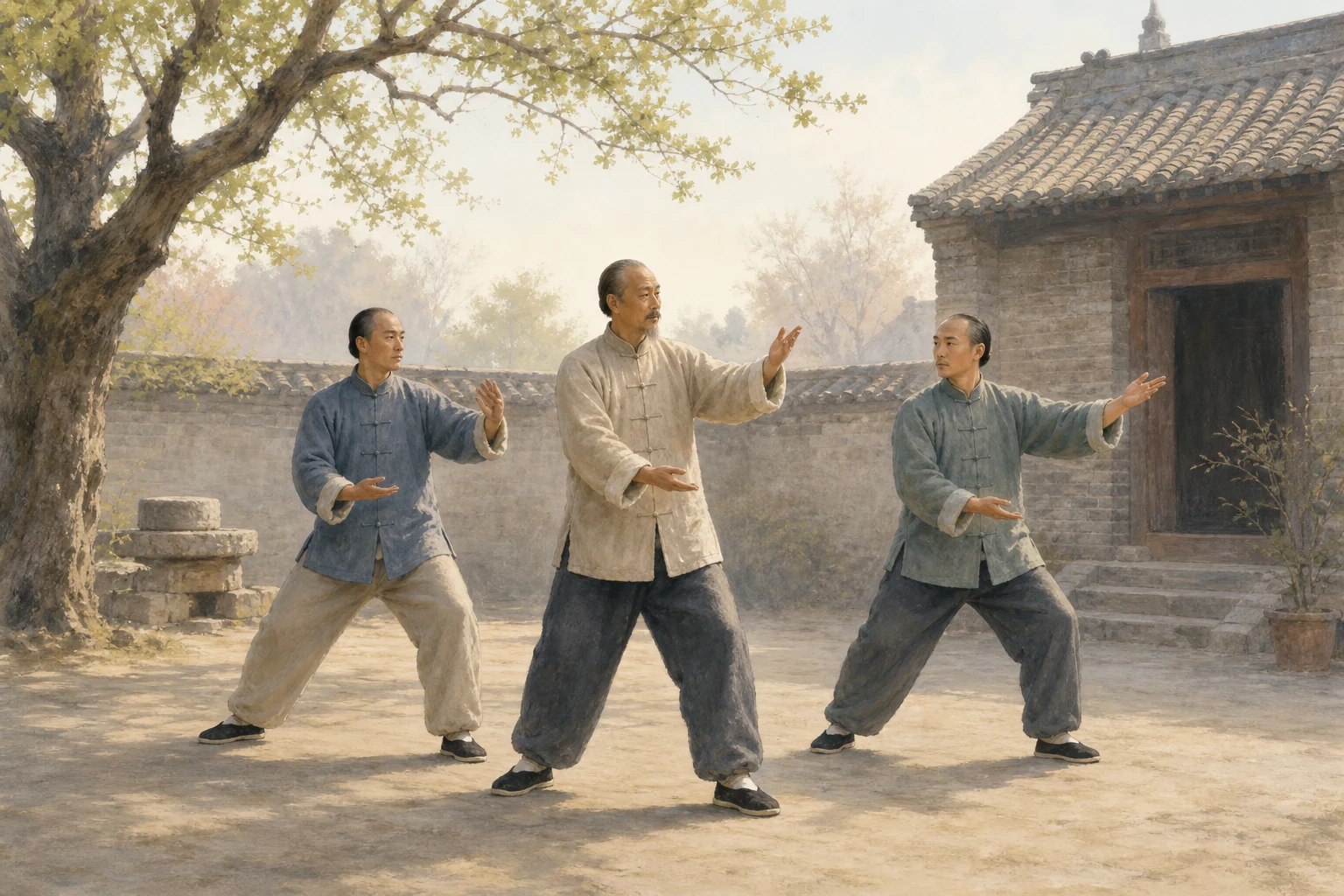
The documented history of Tai Chi centres on Henan Province in the seventeenth century and traditions associated with the Chen family. In the nineteenth century, Yang Luchan helped bring the practice to Beijing and a wider public. Later generations developed several family styles, shorter forms and approaches emphasizing health and meditation.
Why the origins are debated
Tai Chi was long transmitted in families and through direct teacher-student relationships. Written records from the early period are limited, and later lineage stories cannot always be independently verified. It is therefore helpful to distinguish cultural tradition from a claim that can be established precisely through historical evidence.
UNESCO states that taijiquan originated around the mid-seventeenth century in Wen County, Henan Province. Scholarship also cautions that reconstructing anything before the seventeenth century is difficult. Older philosophical and movement influences may have existed, but they cannot simply be arranged into an uninterrupted family tree of present-day forms.
The Zhang Sanfeng legend
A well-known legend attributes Tai Chi to the Daoist figure Zhang Sanfeng, often associated with the Wudang Mountains. Versions tell of him observing a contest between animals or receiving knowledge in a dream. The story expresses an enduring idea that sensitivity, timing and adaptation can overcome crude force.
As a cultural narrative it matters, but it should not be presented as the verified biography of a single founder. Historical study of recognizable systems with continuous transmission leads more securely to the Chen family and later teachers.
Chenjiagou and the Chen family
Chenjiagou village in Wen County is central to the early history of Tai Chi. Chen family tradition associates the formation of the system with Chen Wangting, who lived around the transition from the Ming to the Qing dynasty. UNESCO’s nomination material lists him among the important historical figures of the tradition.
Present-day Chen style is not an unchanged photograph of the seventeenth century. Within the family, practice continued to develop, become more systematic and pass through different branches over generations.
Yang Luchan and the journey to Beijing
Yang Luchan (1799–1872) studied in the Chen family environment with Chen Changxing. He later taught in Beijing and became the central figure of the tradition that developed into Yang style. A scholarly account identifies Chen Changxing as the earliest point to which recognizable systems can be traced in an unbroken line.
Later generations developed family styles known as Chen, Yang, Wu/Hao, Wu and Sun. They differ in stance size, rhythm, coordination and teaching method. In different ways, they share an interest in changing between support and release, continuous transitions and attentive movement.
From family transmission to public practice
Around the turn of the twentieth century, Tai Chi was increasingly taught beyond its original families. Public groups appeared in cities, manuals were printed and teachers adapted long forms to new settings. A practice containing several cultural dimensions also became a form of physical education and health-oriented exercise.
In 1956, Chinese sports authorities developed the simplified 24-form, based mainly on Yang-style material. It was intended as a more standardized and accessible routine for the wider public. The 24-form did not replace family styles, but it played a major role in making Tai Chi familiar internationally.
A living tradition and UNESCO recognition
During the twentieth century, teachers and communities carried Tai Chi to other parts of Asia, Europe, the Americas and Australia. Different settings emphasized competition, health-oriented movement, meditation or original martial contexts. Modern forms were shaped by interaction among Chinese traditions, migration, sport and interest in preventive health.
In 2020, taijiquan was inscribed on UNESCO’s Representative List of the Intangible Cultural Heritage of Humanity. The inscription does not declare one school uniquely authentic. It recognizes a living tradition passed on in several ways by different communities.
What history brings to present-day practice
Historical layers remain visible even in calm practice focused on healthy movement. Circular pathways, changes of direction, weight transfers and movement names recall the wider tradition. Tai Chi Bratislava uses these elements without contact or combat training.
Knowing the origins helps us respect the practice without pretending that it never changed. Every modern group selects, explains and adapts material for its setting. The important thing is to state that purpose clearly and not present one current version as the only authentic possibility.
Frequently asked questions
Is Tai Chi thousands of years old?
Its philosophical vocabulary and some older Chinese movement traditions are ancient, but the documented history of a system called taijiquan centres on the period from the seventeenth century onward. Keeping those two levels separate is more accurate.
Who invented Tai Chi?
No single founder can be identified with complete certainty. Chen tradition gives Chen Wangting a major role, while historians trace continuous lineages through later teachers. It is more useful to understand Tai Chi as a long development.
Sources
- UNESCO — Taijiquan
Authoritative account of the Henan origin, living tradition and 2020 UNESCO inscription
- UNESCO — Nomination file No. 00424: Taijiquan
Nomination file with historical and community context for the tradition
- East Asian Science, Technology and Society — Globalisation and the Internal Alchemy in Chinese Martial Arts: The Transmission of Taijiquan to Britain
Scholarly historical overview of early lineages and the modern global transmission of Tai Chi
- General Administration of Sport of China — 河北太极拳简介
Official source on the creation of the simplified 24-form in 1956