
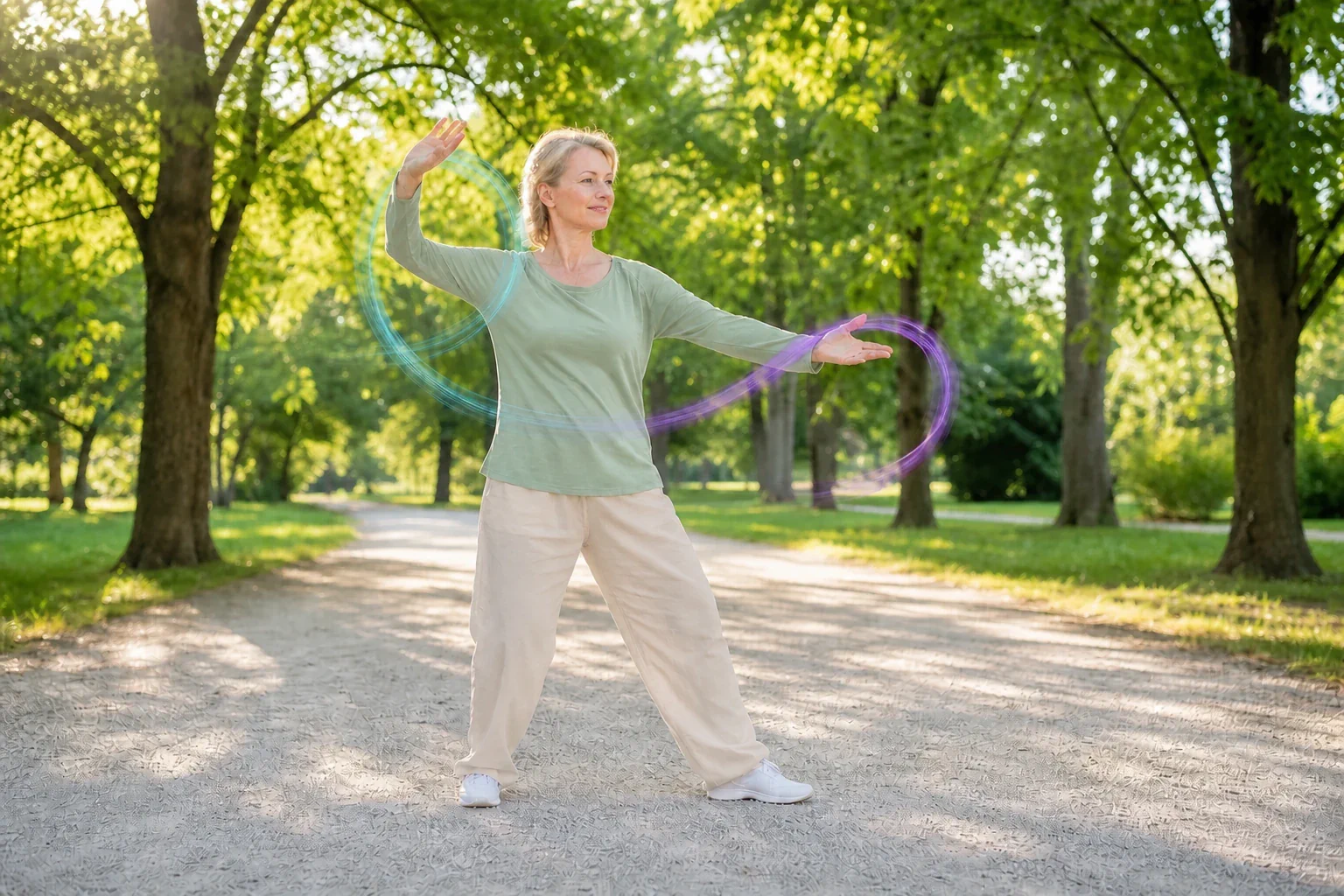
The short answer
Meditation in motion means keeping attention close to what the body is doing now: the support beneath the feet, the transfer of weight, the direction of movement and natural breathing. In Tai Chi, this does not require an empty mind or an unusual mental state. You practise returning to the present movement whenever attention wanders.
Why slow movement can anchor attention
NCCIH describes Tai Chi as a mind-body practice in which people move slowly and gently while breathing and meditating. This is why it is sometimes called moving meditation. Meditation is not a secret technique added on top of the movement. It is the quality of attention you bring to it.
During an ordinary walk, we may think about the destination and barely notice the step itself. In Tai Chi, the step becomes something to investigate. You notice when the foot becomes light, where the knee points, how the trunk adapts and when it is safe to transfer weight. The movement does not have to become perfect; it becomes easier to read.
Four anchors for attention
- Contact with the ground: Notice the heel, the front of the foot and the difference between left and right without manufacturing a special sensation
- Transfer of weight: Observe when one leg carries more weight and the other becomes available to step
- Direction and space: Notice the gaze, trunk, pelvis and foot while remaining aware of your surroundings
- Natural breathing: First notice breath-holding, then allow breathing to continue without forcing it deeper
How it differs from seated meditation
In seated meditation, the main object might be the breath, a sound or a bodily sensation. NCCIH notes that many methods train attention on a specific sensation or on present experience without immediate judgment. In Tai Chi, the object keeps changing: foot, step, hand, direction, breath and back to the foot.
Movement may suit people who find prolonged stillness uncomfortable, but it is not automatically easier. You have to sense the body, surrounding space and order of movements together. When the mind wanders, the aim is not criticism. It is a calm return to one clear task.
A five-minute beginner practice
Stand beside a firm support, with the feet approximately hip-width apart and the knees soft. This is not a test or treatment protocol. If you lose stability, make the range smaller or use the support.
- First minute: Feel the contact of the feet with the ground and allow the shoulders to settle
- Second and third minutes: Slowly transfer weight left and right without lifting the feet
- Fourth minute: Add a simple arm movement only if breathing remains comfortable
- Fifth minute: Make the movement smaller, return to the centre and stand quietly
Common misunderstandings
You do not have to stop thinking. Thoughts appear, and the practice is returning to movement rather than fighting the mind. Extremely slow movement is not automatically more meditative either. If it creates tension or instability, choose a calm, flowing pace.
Comfortable breathing may support a sense of ease, but Tai Chi and meditation do not replace professional care for anxiety, depression or another health condition. NCCIH cautions that meditation research is varied and that some findings have been interpreted too optimistically.
When attention wanders
A wandering mind is not a failure to be corrected by force. It is the moment you notice that movement is no longer the focus. Choose one concrete anchor, such as pressure beneath the foot, and continue from there. A simple return adds less tension.
Noise, worry or trying to remember the sequence may pull attention away. You do not have to solve everything together. Orient to the space, check your support and only then continue. That return is part of the practice, not a break from it.
- Name it: Quietly notice that attention has moved away
- Return: Choose the foot, direction or breath as one clear anchor
Frequently asked questions
Is meditation in motion a religious practice?
It does not have to be. In our practice it is a secular way of working with attention, the body and movement. Participants can retain their own beliefs.
Can Tai Chi reduce stress?
Some people find the calm pace and focused attention subjectively relaxing. Research is exploring possible effects, but results do not guarantee an individual outcome and vary with the population and program.
Sources
- National Center for Complementary and Integrative Health — Terms Related to Complementary and Integrative Health
Definition of Tai Chi as a mind-body practice that is sometimes called moving meditation
- National Center for Complementary and Integrative Health — Meditation and Mindfulness: Effectiveness and Safety
Overview of definitions, research limitations and safety considerations for meditation approaches