
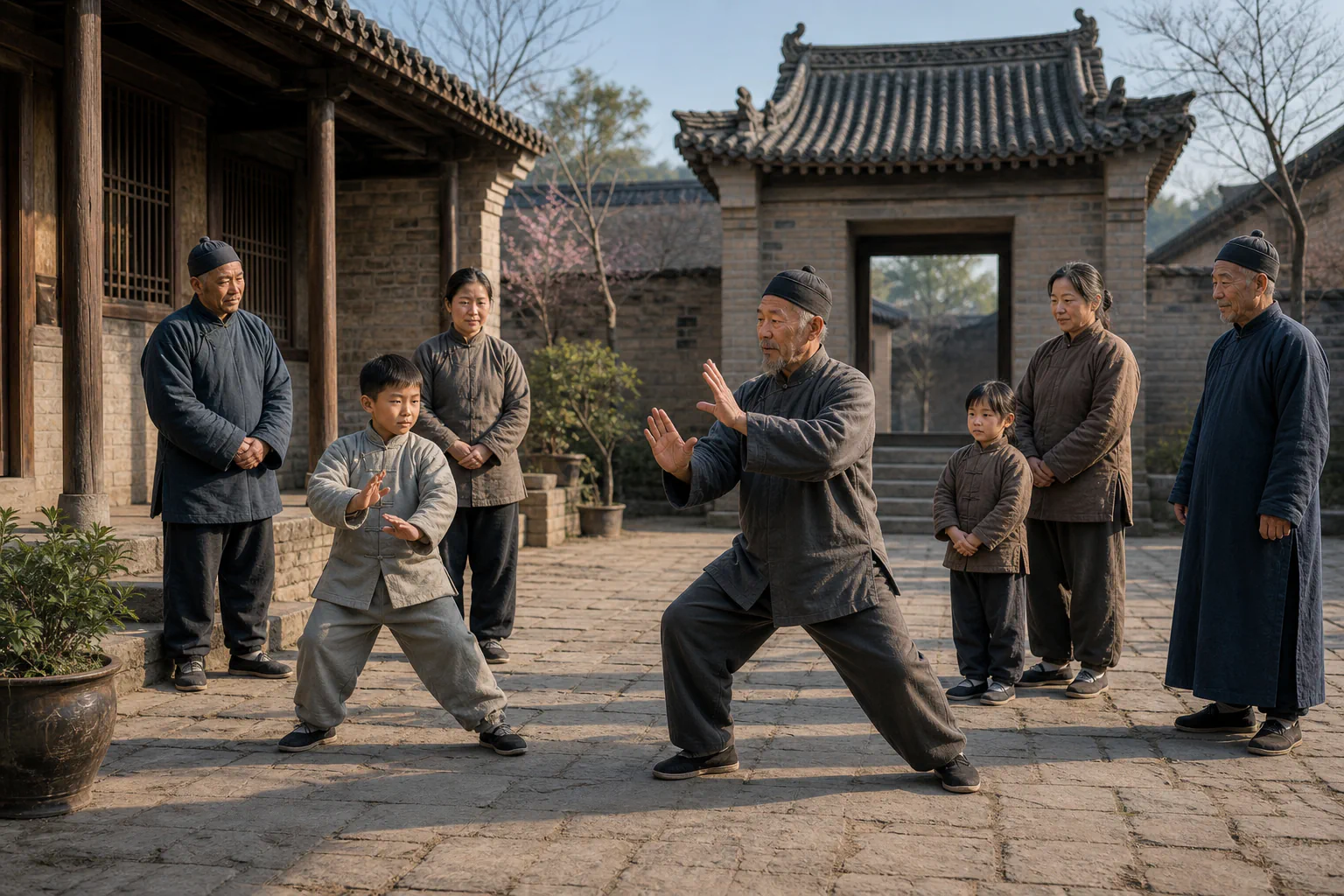
The short answer
UNESCO associates the documented Taijiquan tradition with Wenxian County in Henan Province from around the mid-seventeenth century. Chenjiagou and the Chen family are central to its early development. The exact question of who created each element and in what sequence remains historically debated, so it is more accurate to describe a tradition being formed and transmitted than a single simple moment of origin.
What is documented with reasonable confidence
UNESCO describes Taijiquan as a living traditional physical practice and places its documented origins in mid-seventeenth-century Wenxian County, Henan Province. Chenjiagou, a village closely linked with the Chen family, lies in that setting and is central to the early development of what is now called Tai Chi.
This does not mean that every form of practice appeared at once, or that every later style can be reduced to one finished routine. The documented frame is more useful for seeing a network of people, families, students and ways of passing knowledge on.
Why the Chen family is central to the story
Family tradition connects Chenjiagou with Chen Wangting around the Ming–Qing transition and with the later keeping and development of martial and movement methods within the family. Historical overviews therefore often describe Chen style as the earliest recognisable Tai Chi style.
That wording is not a reason to give one person credit for everything visible in Tai Chi today. Routines, teaching language, emphases and circles of students changed. It is more faithful to read the history as a tradition taking shape over time.
Where tradition meets historical debate
Sources, genealogies, later publications and oral accounts do not carry the same weight or come from the same period. Historians therefore debate dates, the authorship of texts, and relationships among Chenjiagou, other places in Henan and stories associated with Zhang Sanfeng.
That debate is not an invitation to choose the most dramatic legend. It is a reason to state the degree of confidence. When a source reports family memory, it should be called family memory; when it documents transmission, it need not be turned into myth.
From family transmission to a wider world
UNESCO identifies two connected paths of transmission: within clans and through master–apprentice relationships. The latter helps explain how the practice could move beyond one family without erasing its early connection with Chenjiagou.
Yang Luchan is also associated with the Chen environment in the nineteenth century. His later teaching in Beijing belongs to an important chapter in the spread of Tai Chi, but it is not proof that the whole history can be explained by one straight and undisputed line.
A useful way to read this history
For someone starting today, memorising every date need not be the point. It is useful to know that Tai Chi is not modern general stretching with a story added afterwards. It is a practice with particular communities, places and ways of learning.
If a class uses the name of a style or lineage, it is fair to ask what that means in its teaching. A clear, specific answer is more valuable than a grand claim about a single origin.
Common questions
Is Chenjiagou certainly the only birthplace of Tai Chi?
Chenjiagou is a key place in the documented tradition, while the precise history of origins and relationships among sources is debated. It is therefore not accurate to reduce the whole history to one unquestionable moment.
Was Chen Wangting the only founder?
Family tradition strongly connects him with the formation of the system. Historical interpretation distinguishes family memory, later texts and independently documented evidence; a complex practice need not have one sole author.
What does Chen style mean today?
It is a style name associated with the Chen family and Chenjiagou. Teaching differs between schools, so it is useful to ask about content, scope and teaching method rather than relying on the label alone.
Do I need to know the history before I begin?
No. History can give movement context, while a beginning rests on a safe pace, attention and clear feedback.
Sources and historical context
- UNESCO — Taijiquan
Authoritative cultural source: it places the documented tradition in mid-seventeenth-century Wenxian County, Henan, and describes both clan and master–apprentice transmission.
- UNESCO — Taijiquan nomination file
The nomination material gives context for the living practice and its communities; it does not settle every dispute about individual founders.
- Martial Arts Studies — Fighting Words: Four New Document Finds Reignite Old Debates in Taijiquan Historiography
Scholarly historical context for debates around documents, family lineages and overly simple single-origin stories.