
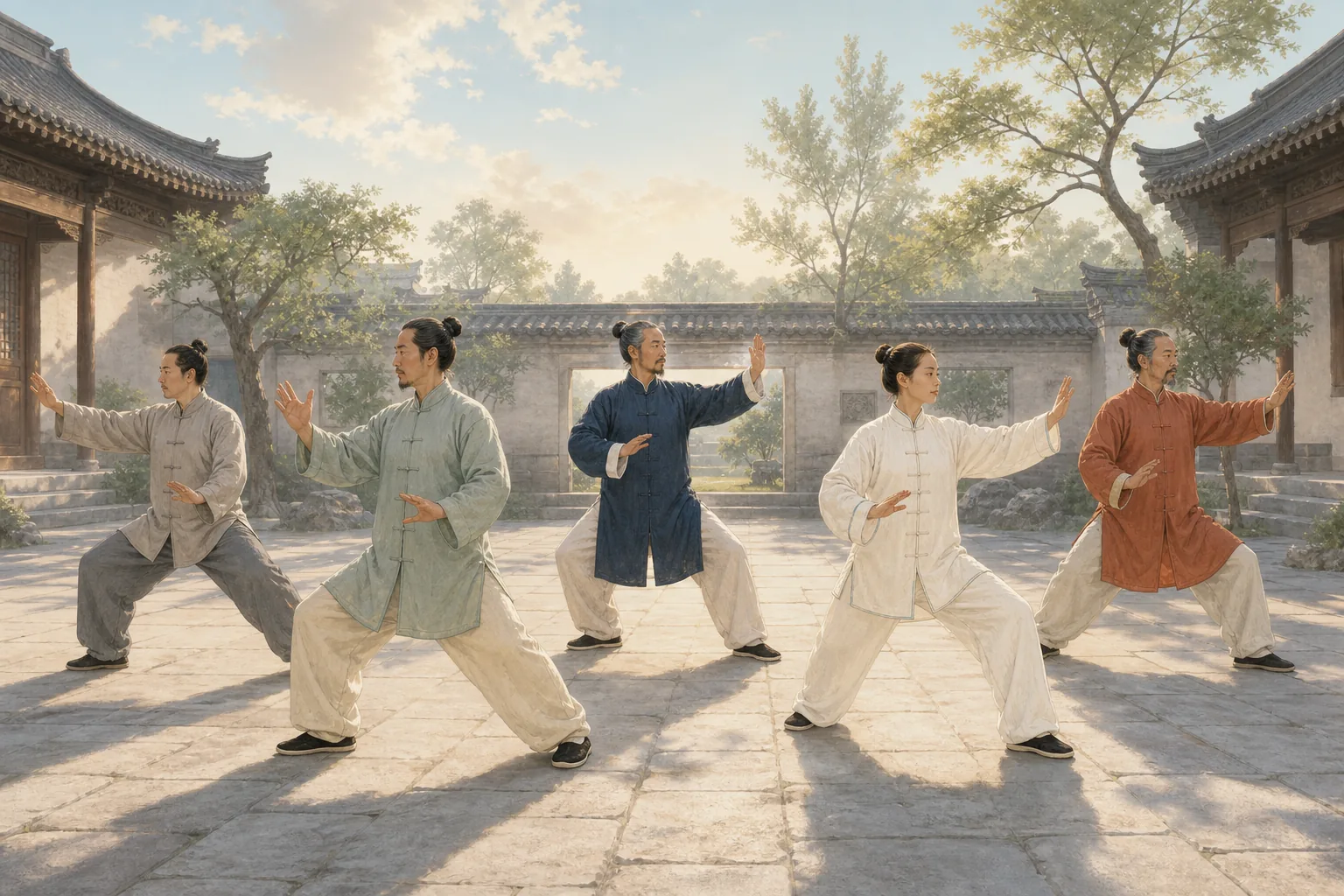
The short answer
The five major family styles of Tai Chi are conventionally named Chen, Yang, Wu/Hao, Wu and Sun. They are not separate inventions without common roots. Yang style grew from what Yang Luchan learned in the Chen family setting; Wu/Hao and Wu developed during the nineteenth century through different students and branches connected with the Yang family; and Sun Lutang created the youngest of the five after studying Wu/Hao and drawing on his deep experience of Xingyiquan and Baguazhang. Each name contains several branches and teaching methods. Typical features are therefore guides, not infallible tests based on one video or posture.
Five styles are a historical map, not a ranking
The phrase five major styles became a practical way to name influential family lineages that spread widely during the nineteenth and twentieth centuries. It does not mean that worthwhile Tai Chi exists only inside this list. There are smaller family branches, local systems, competition and standardized routines, and modern health programmes. The five names help us follow transmission between teachers and generations, but they are not a complete catalogue.
No style remained unchanged. Families moved, teachers adapted methods to different students, routines were shortened or expanded, and some branches emphasized public teaching while others preserved partner work or weapons. It is more accurate to imagine a family of related practices than five sealed packages. The name indicates an origin; the actual content must always be checked in the particular school.
- Chen: The oldest of the five lineages, historically associated with Chenjiagou and the Chen family.
- Yang: The lineage established by Yang Luchan and spread publicly by his descendants, especially Yang Chengfu.
- Wu/Hao: A compact lineage from Wu Yuxiang through Li Yiyu and Hao Weizhen; Hao distinguishes it from the other Wu style.
- Wu: The lineage of Quan You and Wu Jianquan, developed in the Beijing environment of Yang-family teaching.
- Sun: The youngest of the five, created by Sun Lutang in the early twentieth century after his study of Wu/Hao.
A shared family tree: the styles did not arise in a vacuum
The simplest historical map begins in Chenjiagou. The stable transmission account has Yang Luchan studying with Chen Changxing and later teaching in Yongnian and Beijing. His teaching and that of his sons opened several routes. Wu Yuxiang studied within the Yang family circle and also sought out Chen Qingping; the line through Wu Yuxiang, Li Yiyu and Hao Weizhen developed into what is now called Wu/Hao. Quan You is connected with Yang Luchan and Yang Banhou; his son Wu Jianquan became the central figure of the other Wu style.
Sun Lutang entered this story later. He was already an experienced practitioner of Xingyiquan and Baguazhang when he studied Tai Chi with Hao Weizhen. His lineage is therefore not an accidental mixture of three arts, but a coherent system arranged by someone who understood their principles from within. The family tree shows that innovation in Tai Chi often arose through deep study and new pedagogical organization, not by rejecting the previous tradition.
Chen: village tradition, spiralling power and changes of tempo
Chen style is associated with Chenjiagou village in Henan and the Chen family. Tradition credits Chen Wangting with systematizing the martial method around the transition from the Ming to the Qing dynasty, although the detailed reconstruction of its earliest stages remains debated. What matters is that Chenjiagou provides the strongest documented family and community setting from which a later path leads to Yang Luchan and other lineages.
Present-day Chen branches often emphasize spiralling whole-body connection, called chansijin, alternation between softness and explosive release of power, or fajin, changes of rhythm and clear martial structure. This does not mean that every sequence is fast or low. Laojia, or old frame, xinjia, or new frame, and other branches use different ranges, tempos and teaching orders. A beginner may work high and quietly; spectacular online demonstrations do not represent the whole style.
- Historical figures: Chen Wangting, Chen Changxing, Chen Fake and later generations of the Chen family.
- Often visible features: Spiralling paths, pronounced integration of pelvis and torso, variable rhythm and fajin in some routines.
- Common misconception: Chen is not only low, fast and physically demanding Tai Chi; practice varies with branch, routine and level.
Yang: from Yang Luchan to the large open frame
Yang Luchan established the lineage from which Yang style grew, but its best-known modern appearance cannot be attributed to him alone. He transmitted the art to his sons Yang Banhou and Yang Jianhou, while their students developed further branches. During the first third of the twentieth century, his grandson Yang Chengfu taught in several Chinese cities and became crucial to public dissemination. His name is associated with a large open frame, continuous pacing and pedagogy suited to larger groups.
A typical modern Yang routine looks even and calm: transitions are continuous, the torso generally upright, and explosive releases are not conspicuous in the ordinary slow form. Beneath the surface remain the differentiation of full and empty, direction of force, turning and partner sensitivity. It is inaccurate to dismiss Yang as an easy health version of Chen. It is a large family of lineages preserving slow and fast forms, pushing hands, applications and weapons.
- Historical figures: Yang Luchan, Yang Banhou, Yang Jianhou and Yang Chengfu.
- Often visible features: Large legible paths, continuous slow pace, an open frame and relaxation without collapse.
- Common misconception: Modern Yang did not result from one act of simplification; several generations and branches shaped it.
Wu/Hao: the scholarly line of Wu Yuxiang, Li Yiyu and Hao Weizhen
Like Yang Luchan, Wu Yuxiang came from the Yongnian area. He learned within the Yang family circle and later from Chen Qingping in Zhaobao. An educated member of the local elite, Wu and his family played an important role in preserving and formulating texts now known as the Tai Chi classics. The lineage continued through his nephew Li Yiyu to Hao Weizhen. Hao’s name is now added to prevent confusion with the Wu Jianquan family line.
Wu/Hao is often described as compact, subtle and technically concentrated. Movements may be smaller, stances higher and work with balance, centre and internal organization less obvious to an observer. These shortcuts are helpful but incomplete. Small range does not mean small effect or easy practice; tiny changes of axis, loading and intent demand precision and sensitive instruction.
- Historical figures: Wu Yuxiang, Li Yiyu and Hao Weizhen.
- Often visible features: Compact frame, higher stances, economical steps and emphasis on subtle internal changes.
- Common misconception: Wu/Hao is not another spelling of Wu Jianquan style; it has a different genealogy.
Two names written “Wu”: the same Romanization, different characters
Confusion arises because two different Chinese surnames are both Romanized Wu in pinyin. Wu Yuxiang’s surname uses the character 武, while Wu Jianquan’s family uses 吳, simplified as 吴. Older Western systems produce spellings such as Wu, Woo, Hao or Wu/Hao. Adding Hao does not claim that Hao Weizhen was the sole founder; it is a practical label distinguishing the line that began with Wu Yuxiang.
It is therefore not enough to ask, “Do you practise Wu?” A clearer question is whether this means Wu/Hao associated with Wu Yuxiang and Hao Weizhen, or the family style of Quan You and Wu Jianquan. The difference is not merely orthographic. The lines have separate genealogies, repertoires, textual histories and characteristic teaching emphases.
Wu: the Beijing lineage of Quan You and Wu Jianquan
Quan You was a Manchu military officer in Beijing, and lineage tradition connects his study with Yang Luchan and Yang Banhou. His son Wu Jianquan developed and publicly taught the family method; he moved to Shanghai in 1928 and established an association bearing his name there in the 1930s. The line spread further through Wu Gongyi in Hong Kong, Wu Yinghua and Ma Yueliang in Shanghai, and other family and non-family teachers.
Wu style is often recognized by a narrower stance, smaller circles and the characteristic inclination of the whole torso in some positions. Whole is crucial: this is not bending at the waist or collapsing the chest. Northern and southern branches can look different. The traditional curriculum contains slow and fast forms, pushing hands, partner routines and weapons, so it cannot be reduced to one silhouette.
- Historical figures: Quan You, Wu Jianquan, Wu Gongyi, Wu Yinghua and Ma Yueliang.
- Often visible features: A more compact frame, narrower steps, subtle circles and, in some branches, an axis inclined as one unit.
- Common misconception: An inclined posture is not a lost axis; when correctly performed, the body remains organized and supported by the legs.
Sun: the youngest style and experience of three internal arts
Sun Lutang was already a respected representative of Xingyiquan and Baguazhang before studying Tai Chi with Hao Weizhen. In the early twentieth century he organized his own method, now known as Sun style. His importance goes beyond creating a routine: he was among the authors who wrote systematically about internal martial arts and connected martial training with self-cultivation, health and the Chinese intellectual vocabulary of his time.
Sun style is known for lively natural stepping, in which the rear foot often follows an advance and the front foot draws in after a retreat. Movement tends to be compact, stances relatively high and opening-and-closing of the hands a recognizable motif. Xingyi and Bagua influence can be seen in stepping and body organization, but Sun Tai Chi is not a collage of arbitrary pieces. It is a distinct lineage with its own repertoire and transmission through Sun’s family and students.
- Historical figures: Sun Lutang, his son Sun Cunzhou, daughter Sun Jianyun and other family students.
- Often visible features: Lively follow steps, a higher compact frame and a clear opening-and-closing motif.
- Common misconception: Higher stances do not mean the style was created merely as rehabilitation or exercise for older people.
What can be compared — and what cannot
For orientation, one can look at frame size, stance height, rhythm, stepping, visible spirals and whether fajin appears in basic routines. Chen often shows greater changes of pace; modern Yang a continuous even flow; Wu/Hao compact changes; Wu a narrower frame and distinctive axis; Sun a mobile follow step. These are tendencies, not rules.
An advanced branch may outwardly resemble another style more than a popular demonstration of its own. Large and small circles can be trained within one system, a slow routine can prepare fast application, and stance height changes with the practitioner. A context-free video cannot reliably establish genealogy or quality. Accurate comparison requires knowing the routine, transmission line and purpose of the demonstration.
Shared principles beneath different surfaces
The five styles use different movement vocabularies but share basic questions: how to maintain an axis without stiffness, distinguish a full from an empty leg, conduct movement from support through the torso, respond to force without crude resistance, and connect attention with the whole body. Classical terms receive different interpretations, but no major line is built only on copying hand shapes.
The difference between styles cannot be reduced to soft versus hard, health versus martial, or easy versus advanced. Any style can be practised superficially or deeply. Historical combat functions, solo routines, partner work and modern health use form different layers. A particular school may teach some and not others; readers should distinguish an entire tradition from one group’s curriculum.
How to choose without searching for a winner
For a beginner, an accessible good teacher usually matters more than a theoretically ideal style. Notice whether explanations make sense, movement can be adapted without shame, the teacher distinguishes tradition from health promises and can explain the origin of the material. A good group need not display the entire historical curriculum, but it should describe its actual scope honestly.
It is reasonable to begin with an aesthetic or history that attracts you. Chen may appeal through variable dynamics, Yang through large continuous movement, Wu/Hao through precise compactness, Wu through refined partner work and Sun through mobile stepping. Personal experience may overturn the stereotype. For the current teaching approach in Bratislava, ask privately through WhatsApp; this public article intentionally omits changing organizational details.
- Ask about transmission: Add to the style name a question about the teachers and branch from which the material comes.
- Observe the teaching: Clear corrections, appropriate pacing and respect for individual capacity matter more than claims of superiority.
- Distrust universal rankings: No single style is best for every body, purpose and stage of life.
Names and Romanizations that prevent confusion
Tai Chi, T’ai Chi Ch’uan and Taijiquan represent the same Chinese term in different Romanization systems. Pinyin gives Taijiquan; Tai Chi remains widespread in Europe. Personal names likewise appear in several forms: Yang Chengfu or Yang Ch’eng-fu, Wu Jianquan or Wu Chien-ch’üan, Sun Lutang or Sun Lu-t’ang. A spelling variant does not by itself indicate a different person or lineage.
With the two Wu styles, however, the distinction is more than punctuation. The same Romanized sound represents different Chinese characters and families. This encyclopedia uses Wu/Hao for the line of Wu Yuxiang and Wu for that of Quan You and Wu Jianquan. It is a reading aid, not an attempt to overrule how individual schools name themselves.
Common questions
Which of the five Tai Chi styles is the oldest?
Chen is considered the oldest documented family line within the conventional five and is associated with Chenjiagou. Reconstructing the earliest stages remains a historical question that requires separating documents from later legends.
Are Wu/Hao and Wu the same style?
No. Wu/Hao runs from Wu Yuxiang through Li Yiyu and Hao Weizhen. The other Wu runs from Quan You and Wu Jianquan. Their surnames have the same pinyin spelling but use different Chinese characters.
Is Yang style merely simplified Chen?
No. It grew historically from Chen-family teaching, but several generations of the Yang family and their students established a large independent tradition with its own forms, texts and pedagogy.
Is Sun style mainly for older adults?
No. Its higher stances and mobile steps can be adapted to different people, but Sun style arose as a complete martial art and system of self-cultivation, not an age-limited health programme.
Can a style be identified reliably from a short video?
Typical features sometimes allow a guess, but not a reliable judgement of the whole lineage or teaching quality. Branches differ, and one system may contain large and small, slow and fast forms.
Must I choose a style before my first class?
No. First learn what the particular group teaches, how movement is explained and whether the teaching suits you. A style name begins orientation; it is not a lifelong commitment.
Sources and historical context
- Journal of Sport and Health Science — Tai Ji Quan: An overview of its history, health benefits, and cultural value
A peer-reviewed overview of Tai Chi history and the five classical family styles.
- UNESCO — Nomination file No. 00424: Taijiquan
The official nomination file on Taijiquan’s historical setting, communities and transmission. UNESCO inscription does not settle every historiographical dispute.
- Martial Arts Studies — The Many Lives of Yang Luchan: Mythopoesis, Media, and the Martial Imagination
An academic analysis of Yang Luchan’s historical trace, later biographies and the formation of lineage legends.
- International Yang Family Tai Chi Chuan Association — A Short History of the Yang Family Taijiquan
A Yang-family lineage source for figures and transmission, read as the school’s own tradition rather than independent proof of every detail.
- International Wu Style Tai Chi Chuan Federation — Our History
An official Wu-family lineage source for transmission from Quan You and Wu Jianquan through later generations.
- Revista de Artes Marciales Asiáticas — A Comprehensive Introduction to Sun Family Taiji Boxing: Theory and Applications
A specialist overview of the origins, structure and technical features of Sun style.