
The short answer
The Chinese term sōng (松), written hereafter as song, means relaxation or release in Tai Chi. It does not mean going limp: the body remains supported, movement remains directed and attention stays present. A useful question is not whether you can switch everything off, but what you can stop gripping unnecessarily without losing shape or control. These are noncontact learning examples, not a treatment or a test of mastery.
Why simply telling yourself to relax is not enough
A beginner may respond to relax in two opposite ways. One tries even harder to find the correct position and tenses up while monitoring it. Another lets the arms drop, releases the torso and loses direction. Both are trying to cooperate; the difficulty lies in an unclear picture of what they are meant to change.
For song, it helps to name the actual task. If an arm remains in front of the body, it still needs active work. You can nevertheless investigate whether you are also gripping the fingers or raising the shoulder. Distinguishing necessary effort from excess is not achieved through a single decision. It is learned in particular movements, sometimes with feedback that your own internal feeling cannot provide.
An ordinary image may help: holding an empty cup. You can reduce the squeeze of your hand while the cup remains safely supported. Let go completely, and the task falls apart. This is only an analogy, not a definition of the entire skill of song, but it explains something important: appropriate effort depends on what you are doing. The degree of release suitable for resting is therefore not automatically the right model for an arm that has a movement to perform.
What the Yang principles teach, and what they do not establish
The Ten Essentials attributed to Yang Chengfu connect releasing the waist, letting the shoulders and elbows settle, coordination, and using intention rather than coarse force. The translation published by Yang Family Tai Chi is a primary source for how this lineage explains its own tradition. It is not a clinical trial or an instruction to eliminate muscular activity.
Older explanations also use the traditional language of qi and meridians. We can read that in its historical and teaching context without presenting it as an established anatomical mechanism. A beginner can explore the instruction through observable tasks: where a hand is directed, what supports the weight, and whether a transition continues without abrupt bracing. That work does not first require proof of a special invisible force.
Rigidity, limpness and directed release within the same task
The distinction is easiest to explore within one simple movement, not by comparing rest on a sofa with a demanding sequence. The following are teaching landmarks rather than precise measurements of muscle tension.
- Rigidity: I hold the arm like an unchanging rod. The fingers grip, the shoulder rises and each change of direction looks like a fresh start. Trying to preserve the correct shape makes movement harder.
- Limpness: The arm looks soft, but I lose track of where I am directing it. An elbow or wrist drops independently of the task. Effort has decreased, but organisation has disappeared with it.
- Directed release: The arm retains its intended direction and can change it calmly. I add no unnecessary gripping or shoulder lifting. I can finish the movement safely and understand what I am doing.
An open-palm example: responsive fingers, not forced straightness
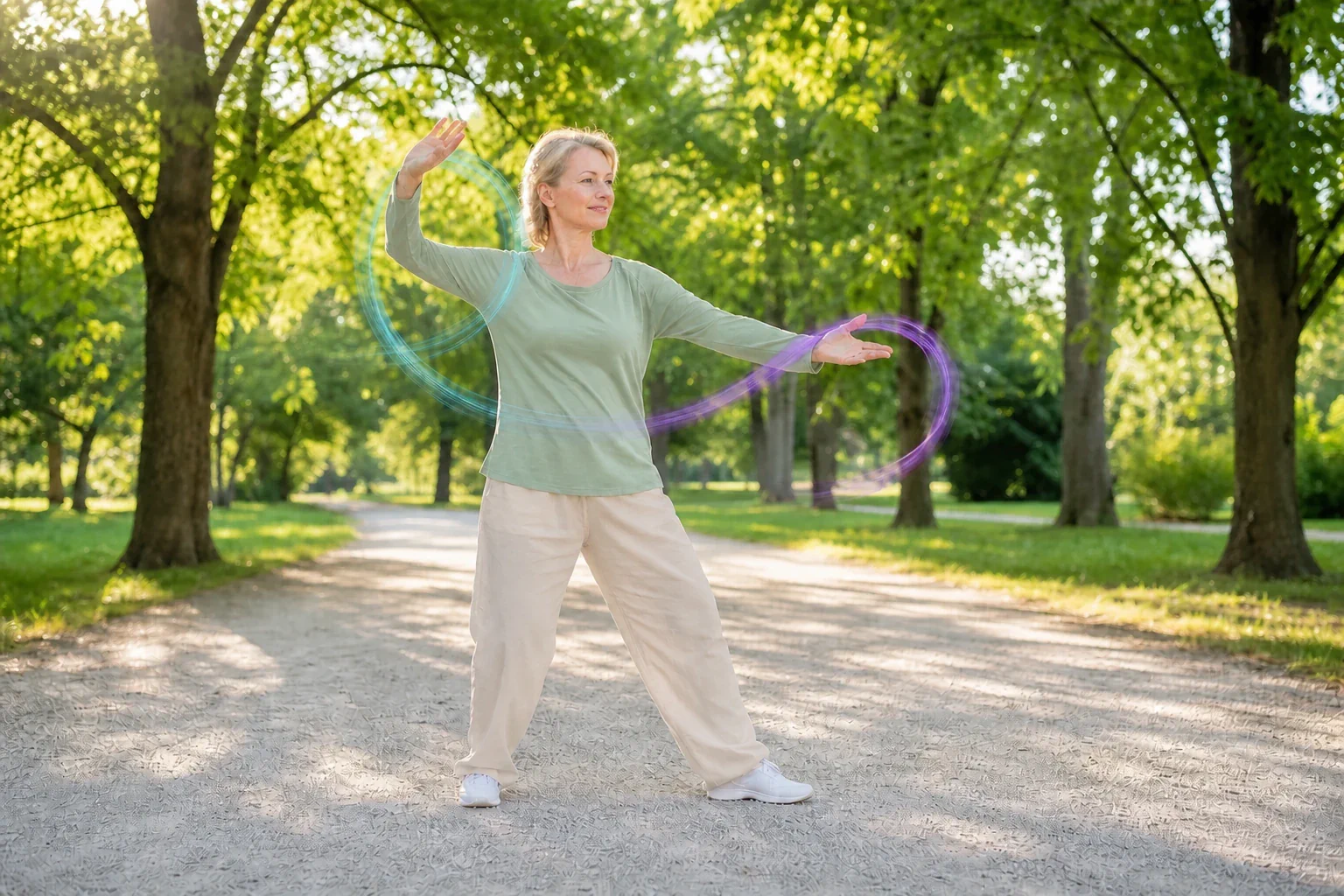
In a comfortable standing or seated position, try guiding an open palm through a small familiar movement. There is no need to test your maximum range or hold the arm up for a long time. Notice whether the thumb, jaw or other hand starts gripping along with it. Choose one of those additions and see whether you can leave it out on the next attempt.
The aim is not to manufacture a perfectly soft hand. The palm still points somewhere, and the fingers need not hang lifelessly. If releasing it makes you lose its orientation completely, return to a smaller movement. The difference may be subtle: the palm remains clear, but you are no longer trying to demonstrate correctness by stretching every finger as far as it will go.
Settled shoulders are not shoulders forced down
The teaching article Body Shape of Traditional Yang Family Tai Chi Chuan I connects relaxation with the organisation of the whole body. Its instruction to let the shoulders settle is not a reason to force them as low as possible. That effort may simply replace one fixed grip with another. Settle should help release unnecessary lifting, not establish a record distance from the ears.
For a simple observation, use an arm movement you already know from class. If the shoulder gradually rises and the task feels strenuous, try less height or a shorter reach and ask for feedback on the position. Do not simultaneously force the elbow against your torso. The arm's shape belongs to the movement; song is not one frozen geometric pattern for every part of a sequence.
A released stance still has to support your weight
When standing, you cannot literally switch the whole body off and remain stable. Appropriate support is therefore the practical aim, not the absence of work. If an instruction to relax makes you suddenly drop into a deeper stance, that does not establish better song. You have changed the height and difficulty of the task, which is different from reducing unnecessary gripping.
Yang Family Tai Chi's second article on body shape shows that organisation changes with the step and particular posture. That does not create an obligation to copy every angle in a picture. When exploring independently, keep a comfortable familiar stance and notice whether you stop breathing or try to remain still by strongly bracing everything. A teacher should demonstrate individual changes to a stance; a general article cannot do that.
Releasing during a step may begin with reducing its size
Imagine a familiar step in which you try to place the foot too far away. At the last moment you brace the shoulders, hold your breath or lurch forward. Telling yourself to relax more may not resolve the distance you cannot currently manage. A smaller step can provide a more useful learning task.
Do not explore this by deliberately losing balance. Use a safe movement you have already been taught and compare comfortable versions only. Notice whether you can distinguish placing a foot from transferring weight onto it. Song is then not a decorative quality added afterwards, but a way of performing a particular transition with less unnecessary tension. Noncontact learning does not require someone to push you unexpectedly.
Breathing and attention provide feedback, not a test of perfect calm
While concentrating on a new sequence, you may notice yourself briefly holding your breath. First simplify the task and allow breathing to continue freely. There is no need to force deeper breaths, slow them to somebody else's pace or attach a precise inhalation to every gesture. If ordinary breathing is uncomfortable during a task, stop; this article cannot determine the cause.
Likewise, you need not wait for a completely empty mind. Attention while exploring song can be specific: today I am noticing only my shoulder as the arm rises. Ten simultaneous corrections may create more monitoring than you can use. Choosing one does not lower the standard of movement; it divides a complex task into understandable steps.
How to ask a teacher about release in concrete terms
Instead of asking whether you have song yet, describe an observable difficulty. For example: when I raise the arm, the shoulder rises too; when I release the shoulder, the hand loses its direction. A teacher can then address a particular height, sequence or range. A general label such as too stiff gives little information without a demonstrated change.
Progress may mean noticing unnecessary gripping earlier, reducing it in a familiar task and preserving the task's purpose. It does not mean you will never feel effort again. Uncertainty may return with a new movement. That is not proof that everything learned has vanished; it is a reminder that release develops in relation to particular skills.
Frequently asked questions
Should song mean having no muscle tension at all?
No. The body must support weight and perform movement. In this teaching context, the aim is to reduce unnecessary effort while retaining support and direction, not to achieve zero muscular activity. A feeling of softness alone does not demonstrate correct execution.
Does an uncomfortable pulling sensation mean I am finally releasing?
Do not draw that conclusion. Discomfort does not confirm song, and pain is not a required test of progress. Reduce or stop the movement and ask for feedback. Persistent symptoms also belong in a discussion with a healthcare professional, not solely an interpretation of Tai Chi principles.
Can I explore song without a partner?
Yes. Noncontact practice allows you to investigate unnecessary hand gripping, shoulder lifting and the direction of familiar transitions. Partner practice introduces other tasks and needs its own instruction. Home exploration does not require improvised pushing tests or resistance to pressure.
Why do I sometimes become stiffer when moving slowly?
You may be trying to control too many details or holding a position that is currently demanding. That is a reason to simplify the task and ask for an explanation, not to move even more slowly at any cost. The particular cause cannot be determined from an article.
Sources
- Yang Family Tai Chi — The Ten Essentials of Tai Chi Chuan
Primary presentation of Yang teaching on release, shoulders and elbows, intention and coordination. Traditional qi explanations are not presented as established biomedicine.
- Yang Family Tai Chi — Body Shape of Traditional Yang Family Tai Chi Chuan I
Primary lineage teaching text on the relationship between relaxation and body organisation. Not an individual prescription for spinal position or clinical proof of efficacy.
- Yang Family Tai Chi — The Body Shape of Traditional Yang Family Tai Chi Chuan II
Primary teaching source showing that body organisation depends on the step and movement. Used to distinguish adaptable organisation from a single fixed shape, not to prescribe stance angles universally.