
The short answer
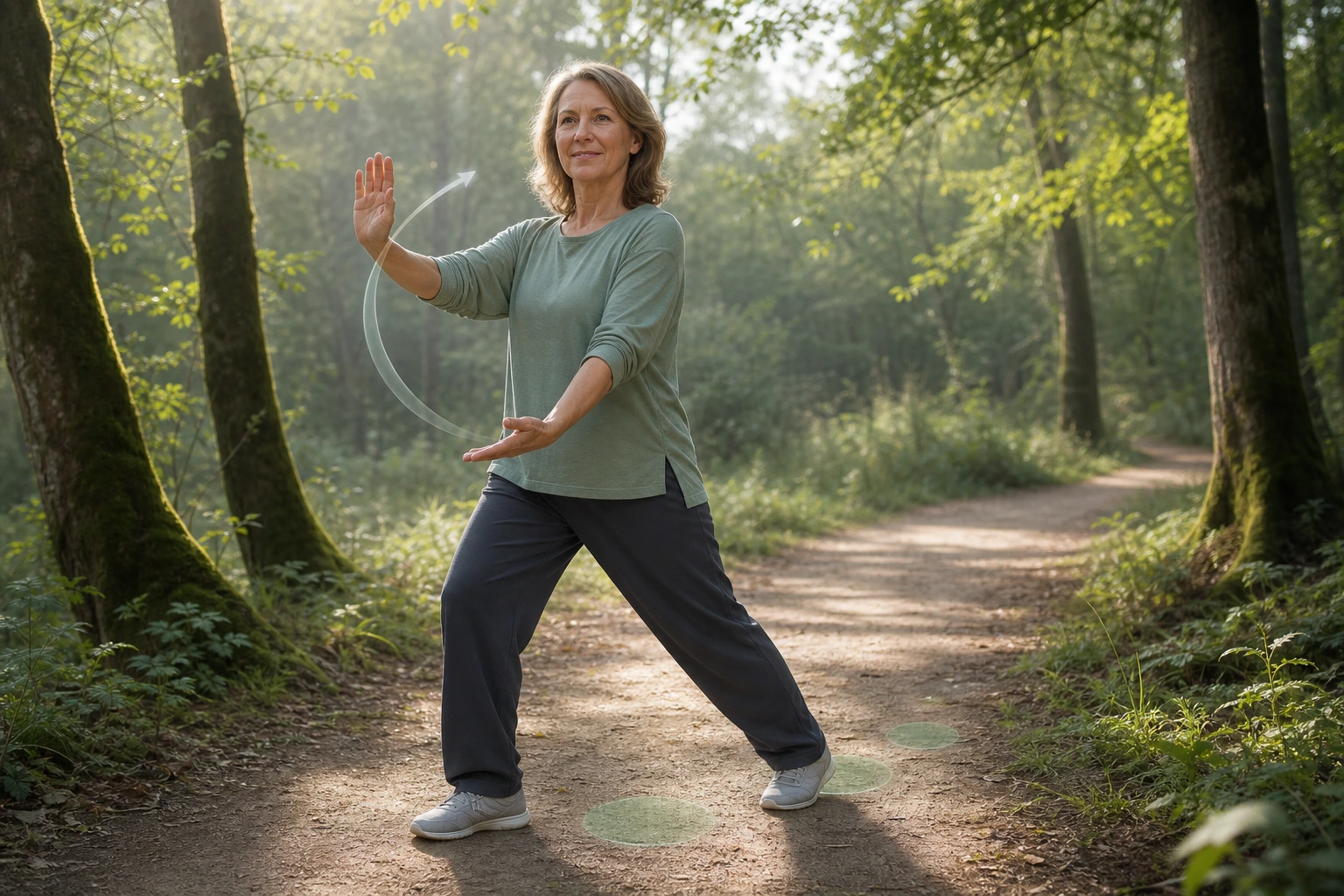
Tai Chi is often practised slowly so you can see and feel how weight transfers, when a foot becomes free, in what order the pelvis, trunk and arms take part, and whether movement remains continuous. Slow tempo enlarges the time available for correction and joins individual parts into one intelligible sequence. It does not mean movement without strength, endless slowing or automatically easy exercise.
Slow tempo works like a magnifying glass
Fast movement can hide uncertainty behind momentum. When you reduce the pace, it becomes clearer whether the standing leg truly carries weight, whether the other foot is free and whether the hands are racing ahead of the body.
A magnifying glass does not fix anything by itself. Slowness matters when you watch one variable and receive feedback. Otherwise an unclear habit can simply be repeated slowly.
Support first, then the step
Many transitions can be read as an order of events: find support, transfer weight, free the other leg and only then place it. Slow tempo makes this order observable.
If a step begins before weight has transferred, the trunk or shoulders often rush to recover balance. A brief pause in a safe position lets you check where the weight actually is.
Slowness reveals order and connection
The hand does not need to act as a separate motor. At a calm pace you can observe how a change in support and direction travels through the pelvis and trunk into the arm. This is readable continuity, not mechanical stiffness.
A teacher may isolate one part briefly to explain it, then return it to the whole. The aim is not to remain among dismantled pieces but to rebuild a connected transition.
Pauses serve learning; continuity serves practice
During learning it is useful to stop where support or direction disappears. The pause creates time for a correction, another attempt and a comparison before and after a small change.
As the order becomes clearer, the checkpoints join together. Good slow practice should not look like frozen photographs; it continues without sudden acceleration or empty waiting.
Slow does not automatically mean easy
A longer weight transfer can demand attention and postural control. Difficulty should not be manufactured through an unnecessarily deep stance, held breath or movement through pain.
Make the range smaller, raise the stance and divide the movement when needed. Technical clarity matters more than impressive depth. Use stable support and live correction when uncertain.
From slow investigation towards a natural rhythm
Tempo can change during learning. First investigate a detail slowly, then connect it to neighbouring movements and check whether its quality remains at a slightly more natural rhythm.
Speed is not added in a leap or as a test of courage. It changes only while support, direction and continuity remain readable. Slow practice is a coordination laboratory, not a promise that every movement must always take the same time.
Questions about slow Tai Chi
Is Tai Chi slow only because it is for beginners?
No. Slow tempo is a way to investigate support, order and connections. It gives beginners time to orient themselves, but experienced practitioners also use detailed slow practice.
Does slow Tai Chi mean the exercise is easy?
Not automatically. Controlled weight transfer and sustained attention can be demanding. Range and stance height can be adapted; the complete beginner guide introduces the first step without assuming prior fitness.
Should I pause in every movement?
A brief pause can expose a problem while learning. After correction, the checkpoints reconnect into continuous movement; the aim is not a form made of static poses.
Should I practise as slowly as possible?
No. The useful pace is one where support, natural breathing and continuity remain. Extreme slowing that creates tension or fragmentation is not the goal.
When can movement become slightly faster?
When its order remains clear and support does not disappear. Change the tempo modestly, observe one variable and return to the slower version if quality breaks down.
Sources
- UNESCO — Taijiquan
Authoritative description of the tradition's characteristic circular and relaxed movement
- National Center for Complementary and Integrative Health — Tai Chi: What You Need To Know
Official overview of Tai Chi as a practice using slow movements, mental focus and controlled breathing