
The short answer
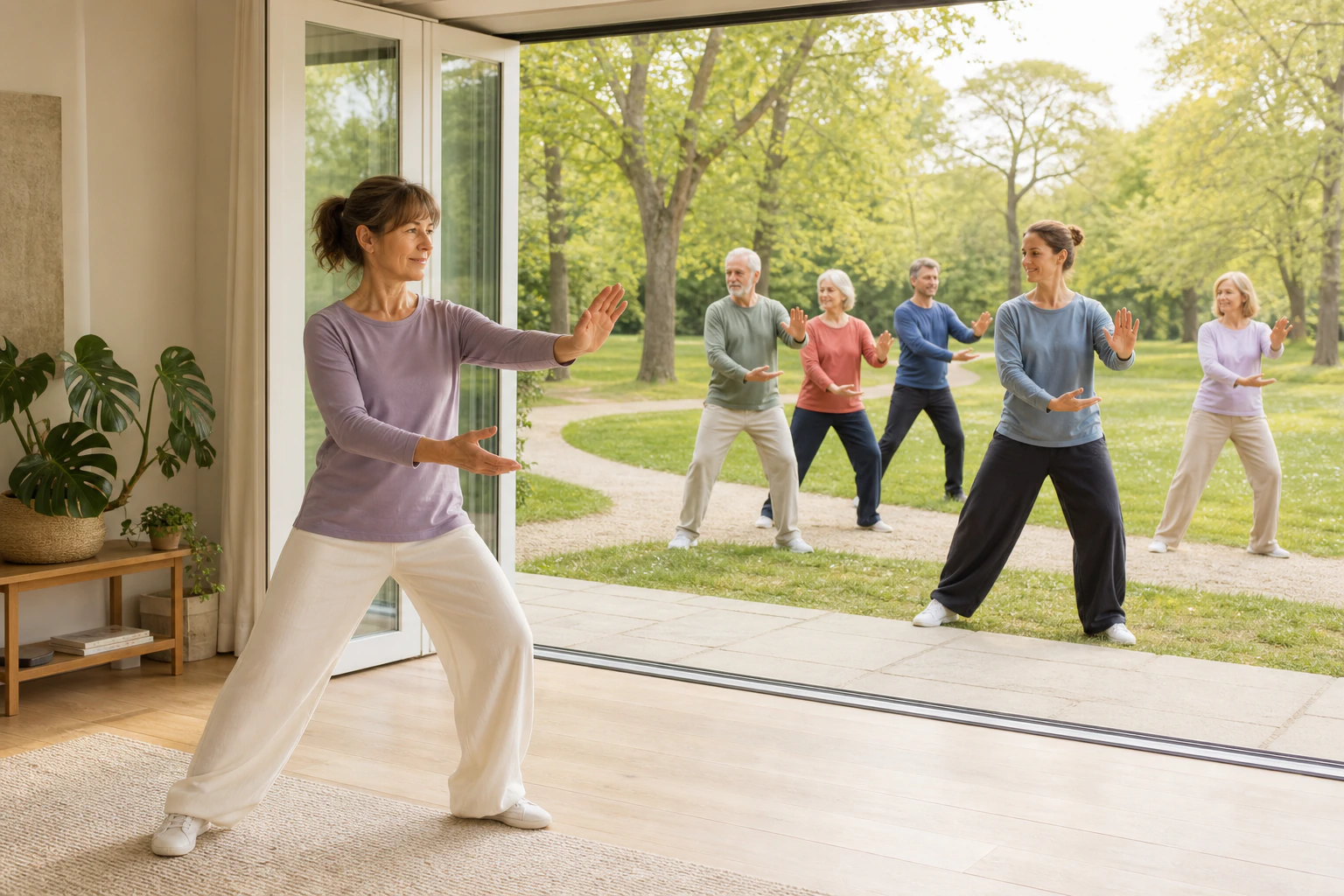
A beginner does not have to choose permanently between Tai Chi at home and a group. At home, it makes sense to repeat a safely remembered stance, weight shift or movement for a short time, because this builds consistency. A group adds a live demonstration, a clear sequence, a manageable pace and technical feedback that a video cannot provide. The most practical option is often a hybrid: learn one small task with an instructor and repeat it calmly at home between lessons. A complete self-taught beginner should stay with simple elements, never push through pain and avoid guessing technical details from a video.
Home and a group solve two different problems
At home, you decide the time, length and pace. You can return to one familiar element without comparing yourself with anyone else and create a small repeatable habit. That freedom is useful when you already know exactly what you are meant to do.
A group lesson reduces a different uncertainty: what to learn, in what order and how to recognise a manageable movement. An instructor can slow down a demonstration, explain support or direction, and notice when a participant has understood a cue differently from what was intended.
The two settings therefore do not compete. A group helps to create a readable map for learning, while home provides quiet space to revisit it. The decision does not have to be ideological; ask which problem you need to solve now.
What makes sense to repeat at home
Home practice is clearest when it contains a small number of elements that you have already seen and remember safely. The aim is not to collect as many online forms as possible. It is more useful to know where to begin, what to observe and when to finish.
- A comfortable stance: Check stable foot contact, natural breathing and a position that does not force you lower
- A slow weight shift: Move only within a range that lets you remain balanced and return calmly
- One familiar movement: Repeat an element whose direction, beginning and end you remember, rather than a random part of a complex form
- A brief finish: Pause, notice your support and identify anything unclear that you can ask about next time
What a guided group adds
A video can show a movement, but it cannot see your attempt. It does not notice whether you are rushing, losing support or reversing a direction. In a small group, the instructor can first let the movement unfold, then choose one priority and check it during the next repetition.
Pacing information matters just as much. Beginners often do not know which detail is foundational and which can wait. Guidance helps separate the essential task from decorative copying of the hands, an unnecessarily deep stance or an attempt to keep up with an advanced video.
A group also creates an agreed time and a calm shared rhythm. This can support consistency for people who keep postponing practice at home. It is not a competition or a performance check, but a setting where a question can be asked at the useful moment.
What research says — and what cannot be reduced to a slogan
NCCIH describes Tai Chi as a practice involving slow, gentle movements, postures, focused attention and controlled breathing. Its overview also notes that studies use different styles, programme lengths and participant groups. One study therefore cannot establish a single best learning format for every beginner.
The RETREAT randomised trial compared remotely delivered Tai Chi with aerobic exercise in a specific population with knee osteoarthritis. It is a useful example showing that structured instruction can work outside a shared room. It is not evidence that every online video equals live teaching, and it is not a treatment recommendation for an ordinary beginner.
For a practical choice, it is more accurate to consider the quality of the task, access to feedback, suitability for your current condition and consistency. A format alone does not guarantee a result. Tai Chi should not replace assessment or treatment for a health problem.
A simple hybrid approach for the first weeks
A beginner does not need to practise a long form between every two lessons. It is more practical to take away one clear task, repeat it briefly and check at the next meeting whether you understood the cue. Home practice then becomes a continuation of learning rather than a parallel course built from random videos.
- In the lesson: Choose one note about support, direction or timing that you can repeat in your own words
- At home: Return only to a safely familiar element and stop before attention or stability begins to deteriorate
- When unsure: Write down a specific question instead of filling missing details with a guess
- At the next lesson: Show how you understood the task and let the instructor adjust only what matters now
How to choose a format without committing for life
If you lack a clear sequence, cannot assess your own movement or are starting from zero, a guided beginner group is usually the clearer first step. If you already have one safe task and mainly need consistency, a short home repetition has real value.
When time or travel is difficult, live online instruction may also be useful if you can ask questions and the instructor can actually see your movement. Use a recording as a reminder of familiar material, not an unlimited source of new technical details.
In Bratislava, you can first ask about the current beginner group without obligation. You do not need a partner, fitness level or a memorised form before your first visit; organisational details are sent privately by WhatsApp.
Common questions about Tai Chi at home and in a group
Can I learn Tai Chi entirely without an instructor?
Home practice can develop consistency and simple elements that you understand safely. Without feedback, however, a complete beginner can easily miss direction, support or an unsuitable range. At least occasional live guidance helps verify what you are actually repeating.
Is an online course the same as an in-person group?
Not automatically. Live online instruction may allow questions and observation, while a recording only presents material. Sharing a room also makes demonstrations from different angles and immediate correction easier.
How much should I learn at home between lessons?
For a beginner, clarity matters more than quantity. Briefly repeat one stance, weight shift or familiar movement. If you are unsure about the direction or sequence, write down the question instead of adding another element by guesswork.
Do I need a partner or special clothes for the first group?
No. Comfortable, loose clothing, light stable shoes and permission to reduce the range are enough. You do not need a partner or prior knowledge of a form.
What if I feel pain or dizziness during home practice?
Stop the practice and do not try to overcome the symptom with a deeper stance or more repetitions. Seek advice from a qualified healthcare professional if symptoms persist or concern you.
Sources and context
- National Center for Complementary and Integrative Health — Tai Chi: What You Need To Know
Official overview of Tai Chi characteristics, available evidence, uncertainties and safety considerations
- National Center for Complementary and Integrative Health — Tai Chi and Qi Gong
Archived public information used for historical context on independent and guided practice, not as current clinical guidance
- JAMA Internal Medicine — Remote Tai Chi Versus Aerobic Exercise for Knee Osteoarthritis: The RETREAT Randomized Clinical Trial
Randomised trial of remotely delivered programmes in a specific population with knee osteoarthritis; the result cannot be generalised to every video or every beginner