
The short answer
Breathing exercises are short, deliberate changes in the pace or manner of breathing. For a simple start, sit or stand with comfortable support, release your shoulders and allow each inhale and exhale to remain gentle, regular and unforced for a few minutes. Counting can help but is optional, and the breath does not need to be maximally deep. Some people report feeling calmer after this kind of pause, but the result is not guaranteed, and current research does not show that one exact rhythm treats stress or a health condition. If you feel dizzy, pressured, uncomfortably short of breath or increasingly anxious, stop the exercise and return to natural breathing.
A breathing exercise is not a contest for the deepest inhale
Ordinary breathing happens mostly without conscious control. During a breathing exercise, you deliberately slow the pace, soften the effort or notice whether inhaling and exhaling remain smooth for a short period. The aim is not to fill the lungs to their limit or take in more air than feels comfortable.
NCCIH includes slow diaphragmatic breathing among relaxation techniques. The phrase “belly breathing” is a practical shorthand: air remains in the lungs, while the lower trunk may move gently as the diaphragm works. Your shoulders do not need to rise and the abdomen should not be pushed out forcefully.
Feeling calmer is one possible result, not compulsory proof of correct technique. Sometimes you simply notice that you were breathing quickly, tightening the shoulders or holding the breath beforehand. That observation can be useful without having to change your mood immediately.
- Gentleness: Do not pull an inhale or exhale to its extreme limit
- Continuity: Avoid competition, forceful pace and prolonged breath-holding
- Comfort: Keep the exercise easy enough to stop at any time
A simple start without a complicated formula
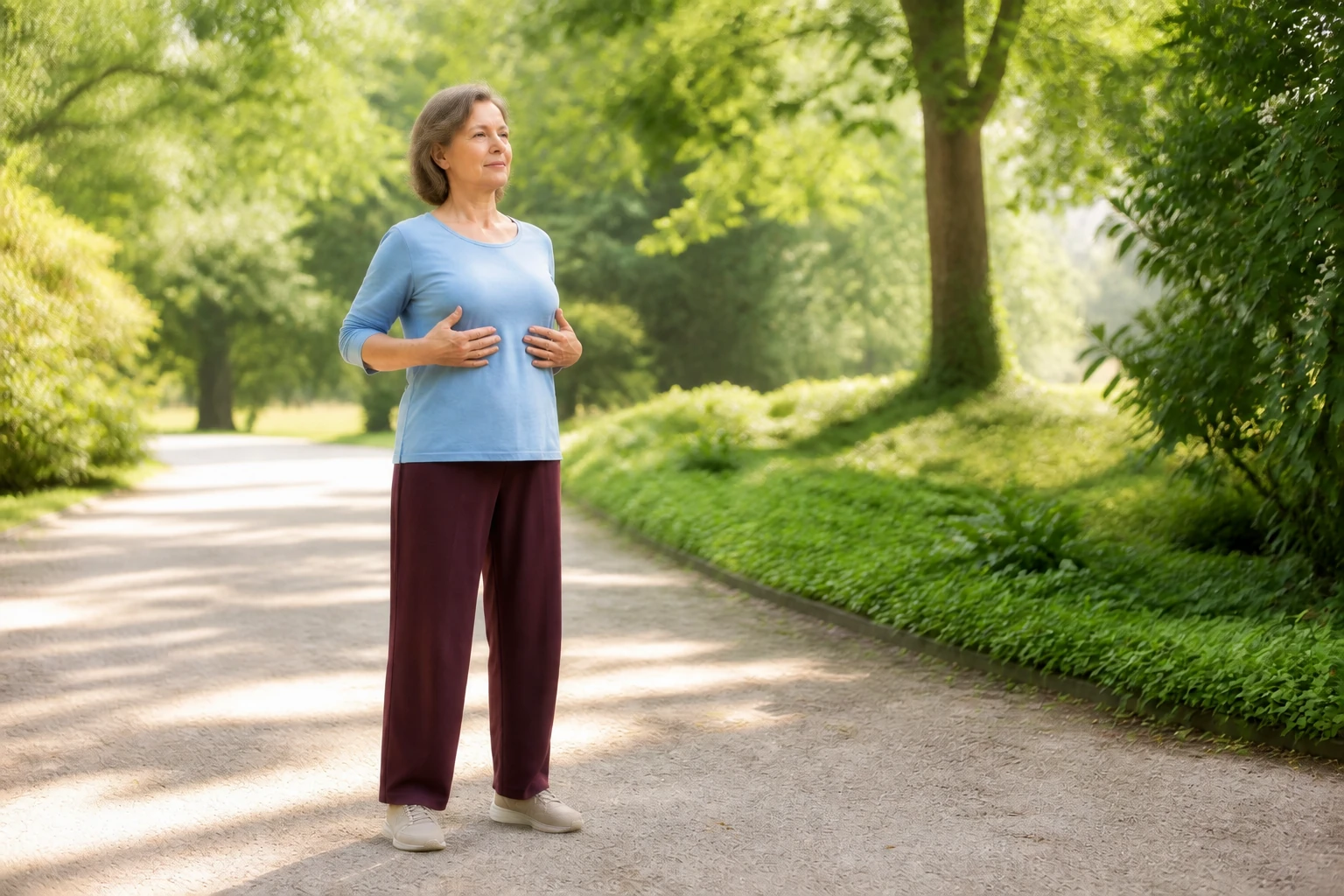
Choose a safe time when you are not driving, operating equipment or doing a task that requires continuous attention. Sit in a stable chair with back support or stand comfortably with your feet on the ground. Loosen clothing that restricts breathing.
Let air enter through the nose as deeply as is comfortable without forceful pulling. Then allow it to leave gently. The NHS suggests an easy inhale and exhale with simple counting if counting is helpful. An unhurried rhythm matters more than reaching a particular number.
About three minutes is enough for a first experiment. This is a practical starting point, not a scientifically established dose. Continue a little longer only if breathing stays comfortable. If you repeatedly need to gasp, take large recovery sighs or force yourself to finish, return to ordinary breathing.
- Find support: Choose stable sitting or comfortable standing
- Release the shoulders: Do not try to lift the whole chest with every inhale
- Breathe gently: Let the inhale and exhale flow without maximum depth
- Check how it feels: After a short while, notice whether continuing remains comfortable and voluntary
Counting is a tool, not a compulsory prescription
The internet offers many exact ratios for inhaling, holding and exhaling. A simple rhythm may help organise the task, but there is no single universal ratio that every healthy adult must use or that guarantees calm.
A beginner does not have to hold the breath. You can let the inhale and exhale remain approximately similar in length and count only as far as is comfortable. If numbers make you tense, omit counting and notice only whether the breath stays unforced and continuous.
A longer exhale can feel pleasant to some people, but it should not be pushed to a sensation of completely empty lungs. Precision is not the objective. It is more useful to recognise facial or shoulder tension, air hunger or dizziness and ease off early.
A short breathing pause needs a sensible place in the day
You might link the exercise to a natural transition: after arriving home, before opening work messages or following a difficult conversation. First make sure you are in a safe place and do not need to monitor traffic or another important task at the same time.
Do not wait until you are completely overwhelmed. Trying the exercise in a neutral moment lets you discover a comfortable pace without the demand that you must calm down immediately. You can later decide whether the same approach is useful on a more demanding day.
A breathing pause may not remove the source of stress. You may still need to resolve a conflict, change working conditions, rest or seek support. The exercise is a small tool for a moment of slowing down, not a substitute for addressing the problem.
- After arriving: Sit down first and then try a short period of quiet breathing
- Between tasks: Create a clear transition instead of handling several things simultaneously
- Before rest: Use the exercise as gentle deceleration, not as a test of whether you can fall asleep
The research is encouraging but not definitive
A 2023 meta-analysis combined 12 randomised trials involving 785 adults. Breathing interventions, most of them slower-paced, were associated with a small-to-moderate average reduction in self-reported stress after the programme compared with control groups that did not practise breathwork.
The authors also judged the overall risk of bias to be moderate. Studies used different methods and durations, and there were too few follow-up measurements to draw a reliable conclusion about lasting effects. The result supports further study and cautious experimentation, not sweeping treatment promises.
An important qualification came from a randomised study of 400 adults. After four weeks, slow coherent breathing was not more effective than a credible, more normally paced control breathing task for stress, anxiety, depressive symptoms, wellbeing or sleep. Both groups spent the same time breathing and received a similar degree of guidance.
Taken together, these findings suggest that a regular quiet pause may be helpful to some people, while an exact slow rhythm may not be the only active ingredient. Expectation, regularity, time set aside and a shift in attention may also matter.
Breathing exercises are not a universal treatment
A change in a self-reported stress score is not evidence that an exercise treats an anxiety disorder, depression, high blood pressure, asthma or another diagnosis. Clinical groups, techniques and outcomes differ between studies, and a general web instruction cannot replace an individual care plan.
A breathing exercise may not calm everyone. Attending to the breath feels neutral to some people and uncomfortable or increasingly anxious to others. Not wanting to continue is not a failure and should not be overcome with more forced breathing.
If you are receiving care for a respiratory, cardiovascular or mental health condition, follow the advice of your healthcare professional. Learn a condition-specific breathing technique from someone who understands your health circumstances.
When to stop and when to seek help
NCCIH says relaxation techniques are generally considered safe for healthy people. However, uncomfortable reactions have occasionally been reported, including increased anxiety, intrusive thoughts or fear of losing control. You do not need to continue at any cost.
If you become dizzy, tingly, pressured, uncomfortably short of breath, increasingly panicked or faint during an exercise, stop deliberately controlling the breath. Sit down or remain safely supported, return to natural breathing and orient yourself to the surroundings.
New or severe chest pain, serious shortness of breath, fainting or another sudden concerning symptom is not a situation for continuing an online breathing exercise. Seek appropriate urgent medical help. For repeated or persistent difficulties, consult a qualified healthcare professional.
A sustainable habit does not need perfect numbers
Begin with one brief daily moment and the same comfortable position. Afterwards, ask one simple question: did my breathing remain unforced, and do I feel the same or more comfortable? If not, shorten the time, remove counting or do not use the exercise.
Regularity does not mean obligation. A missed day does not need to be repaid with a longer session. The aim is to have an accessible low-demand option, not create another task by which you judge your performance.
If breathing practice on its own does not suit you, a quiet transition may also come from a short walk, looking at greenery or gentle movement. A useful tool remains safe, realistic and easy to set aside without blame.
Natural breathing in movement
Natural breathing during Tai Chi
In beginner Tai Chi, you do not need to match every movement to a precisely measured inhale or exhale. The first step is not to hold the breath, exaggerate its depth or move at a pace that makes natural breathing difficult.
Quiet movement may suit some people better than monitoring breathing on its own because attention has concrete external reference points: feet, direction, hands and space. Tai Chi is not breathing therapy and does not replace care for respiratory, cardiovascular or mental health problems.
If calm group practice interests you, you can send a no-obligation WhatsApp message from the home page and ask for the current details. The beginner guide explains the first step without requiring a previous sporting background.
Frequently asked questions
Which breathing exercise is suitable for a beginner?
Choose comfortable sitting or standing and breathe gently and continuously for a few minutes without holding your breath. Simple counting can help but is optional. Stop if you become dizzy, pressured, short of breath or increasingly anxious.
Do I have to inhale through the nose and exhale through the mouth?
The NHS offers this as one simple option, not as a rule for everyone. Comfort and the absence of force matter more. If you have a respiratory condition or an individual treatment plan, follow your professional’s advice.
Should the exhale be longer than the inhale?
It is not compulsory. A slightly longer exhale can feel comfortable to some people, but it should not be forced and you do not need to hold the breath. Research does not establish one exact ratio as universally best.
Can breathing exercises cure stress or anxiety?
No. Some trials show average improvements in self-reported stress, but the evidence has limitations, and a stricter trial found no advantage for one exact slow rhythm over an active control breathing task. An exercise does not replace diagnosis or recommended treatment.
What should I do if I feel dizzy?
Stop deliberately controlling your breathing immediately, sit down or find safe support and return to natural breathing. Seek a healthcare professional for strong, repeated or persistent symptoms and urgent help for a sudden severe symptom.
Sources
- NHS — Breathing exercises for stress
Official practical guidance on comfortable positioning, unforced breathing and optional counting without special equipment
- National Center for Complementary and Integrative Health — Relaxation Techniques: What You Need To Know
Official overview of relaxation and breathing techniques, evidence limitations, possible uncomfortable reactions and the importance of not delaying appropriate care
- Scientific Reports — Effect of breathwork on stress and mental health: a meta-analysis of randomised-controlled trials
Meta-analysis of 12 randomised trials involving 785 adults; found a small-to-moderate average effect on self-reported stress while noting moderate risk of bias and insufficient follow-up
- Scientific Reports — Effect of coherent breathing on mental health and wellbeing: a randomised placebo-controlled trial
Randomised trial of 400 adults using an active breathing control; slow coherent breathing showed no specific advantage for stress, mental health, wellbeing or sleep