
The short answer
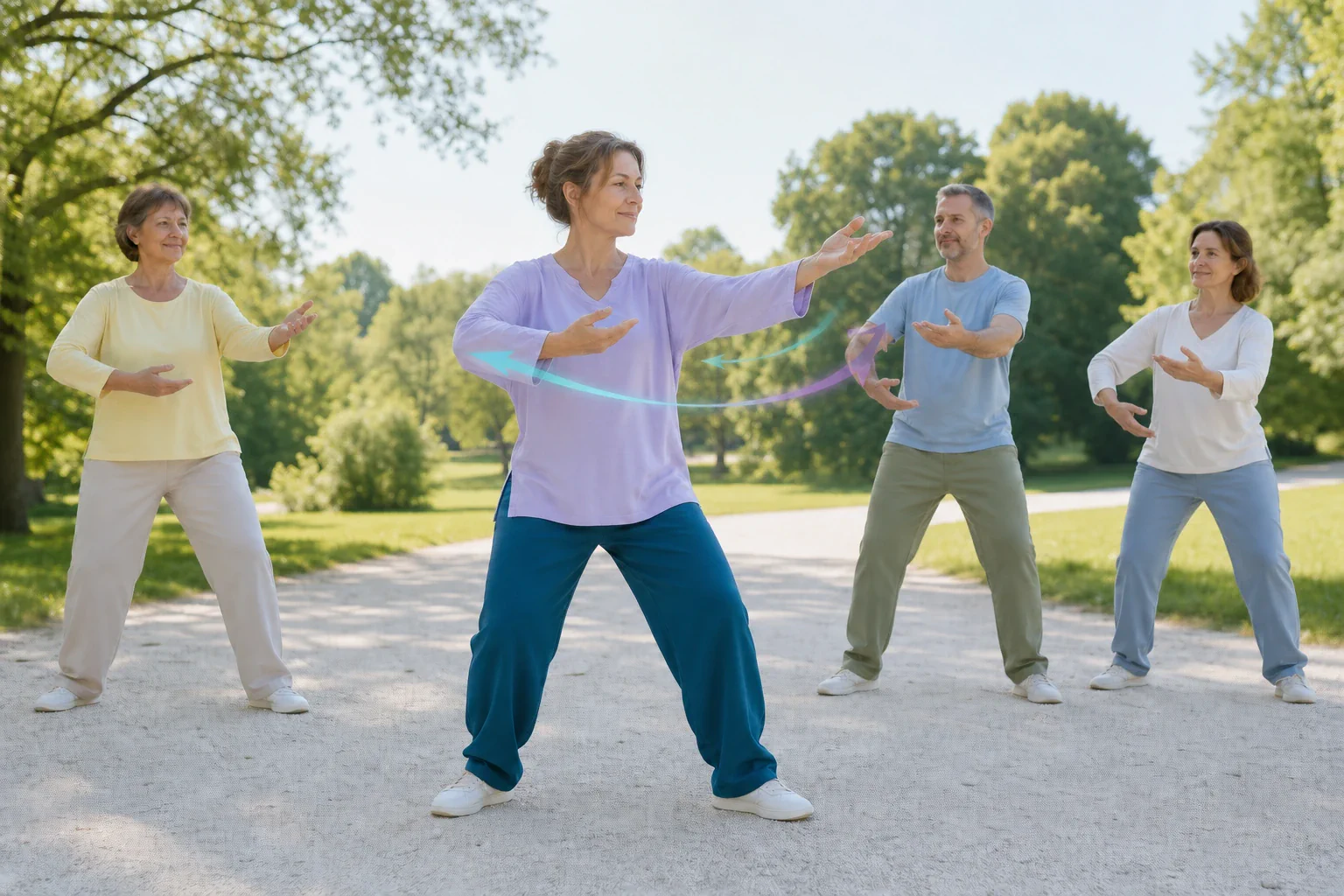
You do not need a sporting background, exceptional flexibility or experience with movement sequences to begin Tai Chi in Bratislava. A beginner learns progressively: a comfortable stance, weight shifting, simple steps and coordination between the arms and body. Tai Chi is still a physical activity performed mainly while standing, so stance depth, step length and pace should reflect each person’s current capacity.
Fitness is not an entry requirement
Many adults postpone a new activity because exercise suggests speed, sweating, competition or comparison. Tai Chi follows a different logic. Movement is slowed down so that you can notice the support beneath your feet, the direction of a step and unnecessary tension.
A beginner does not need a deep stance or a long step. You do not have to keep up with an experienced practitioner or remember a complete passage on the first attempt. It is more important to remain within a stable range and understand one task at a time.
This does not make Tai Chi passive. Slow movement still involves standing, coordination and attention. If you have not exercised for some time, you may notice the work in your legs or find sustained concentration tiring. A sensible starting point is therefore neither the easiest nor the hardest version, but one you can understand and repeat.
You learn a skill before you chase performance
The NCCIH describes Tai Chi as a practice involving slow gentle movements, physical postures, a meditative state of mind and controlled breathing. UNESCO highlights relaxed circular movement working together with breath regulation and focused attention.
For a complete beginner, those descriptions become practical tasks. You learn to notice which leg is supporting more of your weight, when the other foot is ready to step and how the arms can move without unnecessary lifting of the shoulders.
Some of the challenge is coordinative rather than cardiovascular. A slower pace gives you time to observe, but it can also reveal habits that speed usually hides. Confusing a direction or forgetting what comes next is not evidence that you lack talent. It is a normal stage of learning a new movement skill.
- Support: Notice your contact with the ground and transfer weight before you rush into a step
- Coordination: Connect simple movements of the legs, trunk and arms progressively rather than all at once
- Attention: Observe direction, tension and natural breathing without trying to empty the mind
- Continuity: Look for clear transitions that you can slow or pause rather than aiming for speed
How movement can be adjusted
The NCCIH notes that Tai Chi movements can be adapted and that different forms of practice may be performed while walking, standing or sitting. This does not mean that every group offers every version. Ask what adaptations are realistically available in the class you are considering.
In ordinary standing practice, difficulty can be changed without losing the basic movement principle. A higher stance can be as attentive as a deep one, a shorter step can be more precise than a long step, and a smaller arm movement can remain continuous.
- A higher stance: Keep only a gentle softness in the knees instead of sinking deeply
- A shorter step: Place the foot where support still feels clear and comfortable
- A smaller range: Move the arms and trunk only within a range that does not cause sharp pain
- Fewer details at once: Keep direction and balance clear before adding subtler coordination
- A pause: Rest is not failure when it allows the next movement to remain safe and attentive
How to return after a long break from movement
If regular activity has been absent for a long time, the aim of the first few weeks does not have to be a dramatic workout. It is more useful to discover how much standing, stepping and concentration you can repeat without one practice disrupting the rest of your day.
The World Health Organization emphasizes that any amount of physical activity is better than none and that all movement counts. Tai Chi can be one part of a more active life, rather than a substitute for walking, muscle-strengthening activity or every other kind of movement a person needs.
Between group sessions, you do not need to improvise a long form. Briefly repeat a comfortable stance, a simple weight shift or one movement you remember safely. Add consistency before adding many new details.
How appropriate effort feels
During calm beginner practice, you should be able to breathe without forcing or holding your breath and to slow or stop when needed. Mild muscular effort is not the same as sharp pain. Slow movement is not a reason to ignore uncomfortable symptoms.
Notice whether each step remains controlled and whether tiredness begins to turn into unsteadiness. If repetition makes you rush, lean markedly or lose direction, reduce the range, return to a simpler task or take a pause.
- A manageable response: You feel the body working but can calmly adjust the pace and range
- A reason to slow down: Technique becomes unclear, breathing does not settle or standing feels increasingly uncertain
- A reason to stop: You experience sharp pain, dizziness, faintness, chest pain or sudden weakness
When to seek professional advice before starting
The NCCIH concludes that Tai Chi appears generally safe, although minor musculoskeletal aches and pains can occur. A general safety finding cannot determine whether a particular activity is suitable for one individual.
If you have recently had surgery, have a recent injury, unexplained dizziness, repeated falls, fainting, chest pain or a health condition that substantially affects standing or walking, ask a qualified healthcare professional whether this kind of movement is appropriate. Do not use Tai Chi to postpone assessment of a medical problem.
The teacher only needs practical information about a limitation that may affect movement. Do not send medical reports or other health documentation through the website or WhatsApp.
The focus of Tai Chi Bratislava
Tai Chi Bratislava is for adult beginners who want calm movement, more attentive work with balance and meditation in motion without contact or combat training. Fundamental principles are introduced progressively, without pressure to produce a sporting performance.
The current location, practical conditions and price are not published on the website because they may change. You receive them in writing in a personal reply before your first session. A WhatsApp message is only a non-binding enquiry; it does not create a reservation or an obligation to pay.
Frequently asked questions
Can I begin if I have never exercised regularly?
Yes. A genuine complete-beginner group should not require previous sporting experience. It begins with a basic stance, weight shifting and short movements. Individual medical suitability still depends on your health and mobility.
Is Tai Chi easy because it is slow?
Not always. Slowness removes pressure to move quickly, but coordination, standing and attention can still feel unfamiliar and tiring at first. Movements are therefore learned in manageable parts.
What if I cannot remember the movements?
It is normal for a beginner not to remember a complete sequence. Understanding direction, support and one short connection is enough at first. Movement memory develops through repetition.
Do I need special clothing or equipment?
No. Choose ordinary loose clothing that does not restrict stepping or arm movement, together with stable footwear suitable for the surface. Chinese-style clothing and specialist equipment are not required.
How do I get the current group information?
Send a private WhatsApp message. You will receive the current practical and financial conditions in writing before your first session. The enquiry is non-binding.
Sources
- National Center for Complementary and Integrative Health — Tai Chi: What You Need To Know
Official overview of the practice, available safety evidence and the warning not to use Tai Chi to postpone healthcare
- National Center for Complementary and Integrative Health — 5 Tips: What You Should Know About Tai Chi for Health
Concise official description of gentle movement and how different forms of practice may be adapted while walking, standing or sitting
- UNESCO — Taijiquan
Authoritative description of the tradition, relaxed circular movements, breath regulation and focused attention
- World Health Organization — Physical activity
Current overview of the value of regular movement and the principle that any amount of physical activity is better than none