The short answer
In Tai Chi without contact or combat training, you learn individual movement fundamentals: stable stance, smooth weight transfer, stepping direction, coordination of the arms and torso, the order of short passages and returning attention to the task at hand. Each person practises in their own space from the instructor’s demonstration; a partner, sparring or physical confrontation is not required. Tai Chi has historical roots in a Chinese martial art, while a specific beginner class can be taught as calm, non-contact movement practice.
No contact means your own space and a shared demonstration
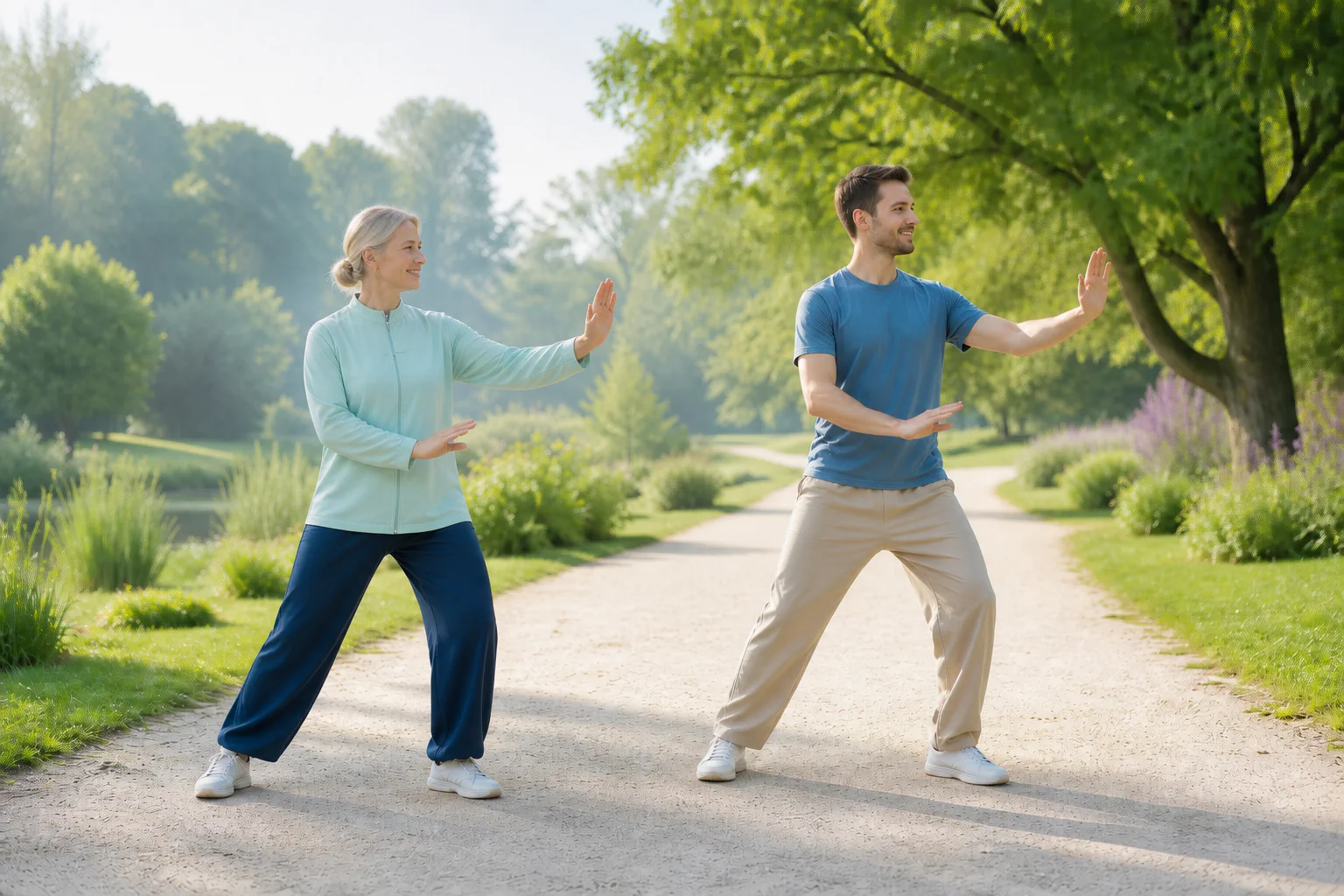
Participants stand far enough apart to step, turn and raise their arms without touching another person. The instructor demonstrates from the front or an angle, names one task, and everyone tries it in their own space. This is not partnered dance or a situation in which one person pushes, blocks or attacks another.
No contact does not mean no guidance. A shared rhythm, visual demonstration and technical correction give practice a structure. The difference is that feedback comes through words, another demonstration or an agreed individual note, not compulsory physical intervention.
You learn stance before an impressive form
The beginning looks simple: the feet have a clear direction, the knees remain within a range you can control, the torso is not forced rigid, and the head is not pulled upwards with effort. The instructor may adjust the width of your stance or ask you to make the movement smaller.
The aim is not to hold one perfect pose. You learn to recognise where you have support and whether you can move calmly from the position. This basic organisation then returns in every step and turn.
- Feet: Direction and spacing that keep the stance readable
- Knees: Soft but not forced deep; the range follows your control
- Torso: Upright without holding the breath or adding unnecessary tension
- Gaze: Calmly follows the direction of movement and the next demonstration
Weight transfer gives a step its order
In ordinary walking, we transfer weight automatically. Tai Chi slows the process so that it becomes clear which leg carries more weight, when the other can release and where the foot can be placed securely. The instructor may simplify the task to a small transfer without a step.
Direction and step length are added afterwards. The goal is not to reach as far as possible or sink as low as possible. You learn to complete one transfer before beginning another and to return to a stable position when the order is lost.
The hands join the body instead of becoming a separate choreography
A beginner often notices the hands first, but movement is organised from support through the legs and torso to the palms. The first task may therefore be only a step and turn. Once the direction is clear, a simple path of one or both hands is added.
Coordination does not mean everything must be simultaneous and exact immediately. Practice separates a passage into smaller parts and then joins them again. If you lose the sequence, return the hands to a neutral position, find the feet and rejoin at the next clear point.
Attention returns to one concrete task
Tai Chi is sometimes described as a mind-body practice. In a non-contact class, that can mean something very practical: noticing pressure through the foot, the direction of the knee, unnecessarily raised shoulders or the moment you speed up. When the mind wanders, you return to one of these anchors.
Breathing is not forced into a performance or an exact number of seconds. During basic learning, it is enough not to hold it and to let it remain natural. The practice does not promise treatment, disease prevention or a special mental state.
Progress comes from repetition and one correction at a time
A short passage is repeated so that every attempt does not introduce completely new movement. The instructor may watch the direction of a foot or the timing of weight transfer, give one concise cue and let you try again. One understandable change is more useful than a list of ten errors.
At home, repeat only a part that you know and can begin and finish safely. You do not need to guess a new order, an unclear position or a movement that causes pain. Group guidance and home repetition have different jobs.
Martial roots and today’s teaching format are different questions
Tai Chi originated in China as a martial art, and its history should not be rewritten. That does not mean every contemporary beginner group must contain sparring, self-defence scenarios or contact drills. A specific programme can choose individual movement fundamentals and a calm way of learning.
This article does not explain belts, competition or the full history of styles; those are separate topics. If you are looking for Tai Chi in Bratislava without contact or combat training, ask directly about the current group format. The website does not publish the exact place, day, time or price; you receive a personal WhatsApp reply and can decide without placing an online order.
Common questions about Tai Chi without contact
Is Tai Chi a martial art if you practise without fighting?
Historically, yes: Tai Chi has roots in a Chinese martial art. A specific modern beginner group can nevertheless focus on individual stance, stepping, coordination and a form without sparring or contact.
Do I need a partner?
No. Each person practises in their own space from a shared demonstration. A partner, paired exchange or physical resistance is not required for the fundamentals described here.
Will the instructor touch me during a correction?
Compulsory physical contact is not part of this format. A correction can be verbal or visual. If another kind of assistance would ever make sense, it should be explained in advance and requires your consent.
What do you learn in the first session?
Usually a simple stance, a small weight transfer, stepping direction and a short hand path. Exact content follows the group; a first visit is not a test of memory or flexibility.
Does this format suit someone who does not want to fight?
Yes, provided the current group genuinely uses a non-contact format. You can ask through WhatsApp before a first visit and decide from the personal reply.
Sources and context
- UNESCO — Taijiquan
Authoritative description of the origin, living tradition and movement characteristics of taijiquan; used for historical context, not to define every contemporary class format
- National Center for Complementary and Integrative Health — Tai Chi: What You Need To Know
Official introduction to Tai Chi as slow gentle movement, physical postures, breathing and attention, together with safety context
- Tai Chi Bratislava — Tai Chi in Bratislava
Current public description of calm practice, the non-contact format and personal WhatsApp contact without publishing changeable organisational details